




In a competitive Australian market, simply having a website isn't enough. Your ideal customers are searching online for local services right now, and if they can't find you, they're finding your competitors. Local Search Engine Optimisation (SEO) is the strategic process of ensuring your business is highly visible in these geographically specific searches. It's a digital transformation strategy designed to connect you with high-intent customers in your service area, turning online visibility into measurable business growth.
At DigitUX, we specialise in engineering these transformations, combining advanced SEO, Answer Engine Optimisation (AEO), and business automation to build a predictable pipeline of local leads for our clients. This guide will walk you through the essential steps to dominate your local market.
Building a Rock-Solid Foundation for Local SEO Dominance
Before launching into advanced strategies, you must establish a flawless foundation. This initial phase is about creating absolute clarity and consistency across your digital presence, ensuring both Google and your customers know exactly who you are, what you do, and where you operate. A shaky foundation will undermine even the most sophisticated digital marketing efforts.
Think of your website as your digital headquarters. It must be technically sound, load quickly, and provide a seamless experience on mobile devices, where a significant portion of local searches occur. Your website is the central source of truth that Google constantly cross-references to verify your business details.
The Critical Role of NAPU Consistency
From this central hub, we establish one of the most fundamental principles in local SEO: NAPU (Name, Address, Phone Number, URL). Ensuring this information is 100% consistent across every online platform is non-negotiable. Mismatched details create confusion for search engines and, more importantly, erode the trust of potential customers.
Imagine a potential client finds one phone number for your business on Google, a different one on TrueLocal, and yet another address on your own website. This inconsistency creates a poor user experience and significantly damages your search rankings. The first step in any professional strategy is a thorough audit to identify and correct these damaging discrepancies.
This flowchart illustrates the foundational process for building local SEO authority, starting with your website, securing NAPU consistency, and advancing toward modern search strategies like AEO.
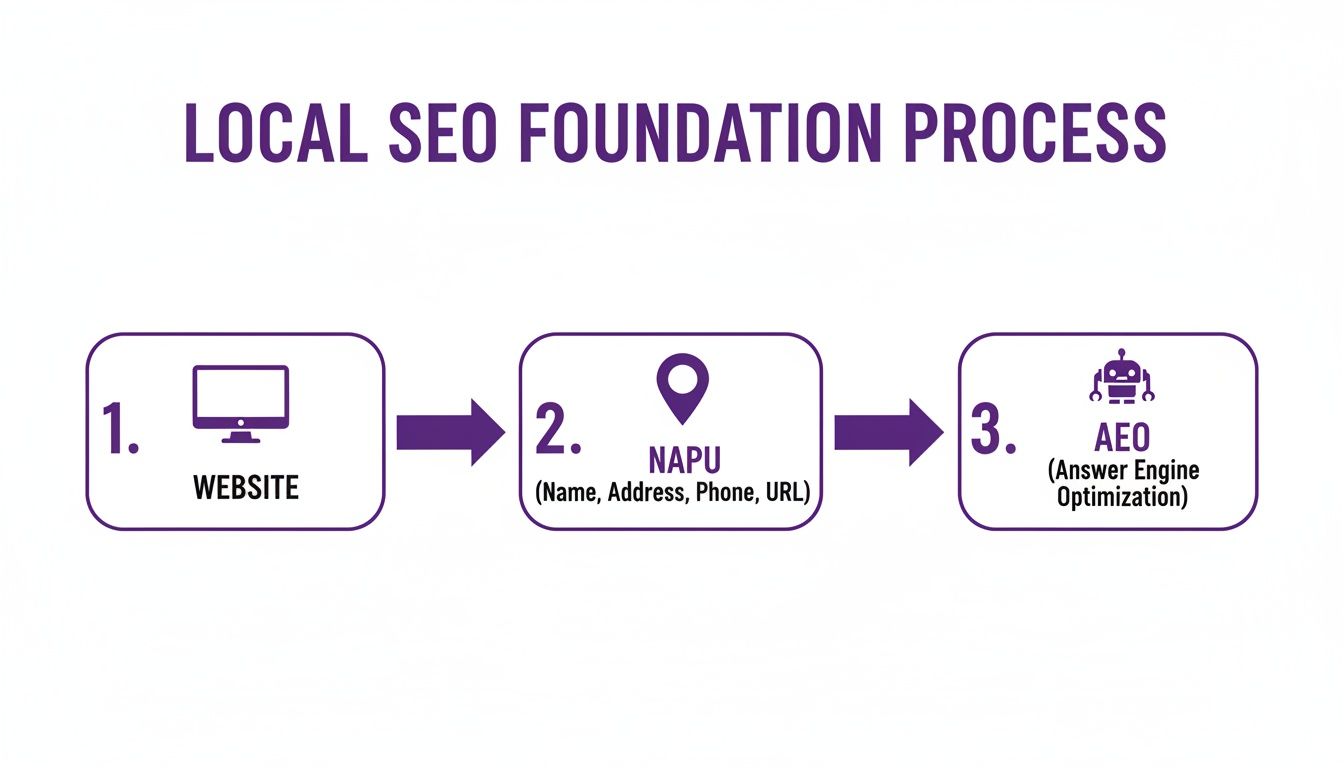
This visual demonstrates how each element builds upon the last, creating a stable platform for long-term growth in local search visibility.
Evolving from SEO to AEO
In today's digital landscape, simply appearing in search results is not enough. You need to be the answer. This is where Answer Engine Optimisation (AEO) comes into play. AEO is the evolution of SEO, focused on structuring your business information so it can be easily understood and served as a direct answer by Google, voice assistants like Siri and Alexa, and AI platforms.
As search becomes more conversational, your goal is to provide the clearest, most authoritative answers to your customers' questions. AEO ensures your business information is structured to meet this demand, making you the go-to source in your local market.
Structuring your data for both humans and machines is a core component of a modern digital strategy. By ensuring your website is technically optimised and your NAPU is flawlessly consistent, you create the perfect launchpad for dominating local search. This foundational work enables more advanced strategies to deliver maximum impact.
Turning Your Google Business Profile Into an Automated Client Magnet
Your Google Business Profile (GBP) is your most valuable piece of digital real estate. It's more than a listing; it's the digital storefront potential Australian customers see first in Google Search and Maps. Optimising your GBP is one of the highest-impact activities for local SEO Australia, delivering tangible results like phone calls, website clicks, and direction requests faster than almost any other tactic.
The goal is to transform this profile from a basic listing into a powerful, automated lead-generation tool by strategically leveraging every feature Google provides to attract, engage, and convert your ideal local clients.
Choosing Categories That Attract High-Value Clients
The first—and most commonly mishandled—step is selecting the right categories. Your primary category is the anchor; it must be as specific as possible to tell Google the core nature of your business.
For example, a law firm in Melbourne shouldn't just choose "Law Firm." If they specialise in family law, selecting "Family Law Attorney" is far more powerful. This helps them appear in more relevant, high-intent searches from clients who need their specific expertise.
Next, maximise your secondary categories to cast a wider net for related services.
- A Brisbane-based plumber might select "Plumber" as their primary category.
- Their secondary categories could include "Gas Fitter," "Hot Water System Supplier," and "Drain Cleaning Service."
This level of detail ensures you're not just visible for "plumber near me," but you also capture customers searching for the specific solutions you provide.
Crafting a Compelling, Solution-Oriented Business Description
You have 750 characters for your business description; treat it as your elevator pitch. This is a prime opportunity to integrate local keywords and clearly articulate your unique value proposition. Don't just list services—tell a concise story that connects with your local audience and solves their problem.
Instead of a generic description like, "We offer plumbing services," try something with more impact:
"As Sydney's trusted emergency plumbers for over 15 years, our team provides fast, reliable service for blocked drains and hot water repairs across the Eastern Suburbs. We're fully licensed, insured, and dedicated to solving your plumbing problems with upfront pricing."
This version integrates keywords ("emergency plumbers," "blocked drains"), a specific service area ("Eastern Suburbs"), and trust signals ("licensed," "insured"). It's a far more effective and professional approach. For a deeper dive, explore our complete guide on what Google Business Profile optimisation entails.
Advanced Strategies to Drive Engagement and Leads
A static, "set-and-forget" profile is an invisible one. To turn your GBP into a true client magnet, you must actively use its engagement features. These actions send strong signals to Google that your business is active, relevant, and helpful to users.
Google Posts
Treat Google Posts as free advertising directly on your profile. Use them weekly to highlight:
- Special offers or promotions (e.g., "End of Financial Year Sale").
- New products or services.
- Company news or photos from a recent project.
- Links to your latest blog articles.
Each post is another opportunity to capture attention and drive traffic to your website.
Q&A Feature
The Questions & Answers section is a powerful but underutilised tool. Proactively populate this area by asking and answering the most common questions your customers have. This allows you to control the narrative, provide valuable information upfront, and overcome potential objections before they arise.
Showcasing Products and Services
Don't just list your services; detail them. Add rich descriptions, prices (where applicable), and high-quality images for each product or service. This transforms your profile into a mini-catalogue, giving potential customers the information they need to make a decision without leaving the search results page.
When you treat your GBP as a dynamic marketing channel, you transform it from a passive listing into an active, automated lead generation machine.
Earning Trust with Australian Citations and Reviews
With your Google Business Profile optimised, the next step is to build local authority. This involves proving to both Google and potential customers that you are a legitimate, trusted, and professional local business. Two critical signals for local SEO Australia are consistent business citations and a steady stream of genuine customer reviews.
Think of it this way: if your business details appear identically across dozens of reputable websites, it signals stability and professionalism to Google. When customers consistently validate this with positive feedback, it confirms that you deliver on your promises. These two elements work in tandem to build undeniable trust.
Building Authority with Australian Business Directories
A citation is any online mention of your business’s Name, Address, and Phone number (NAP). While found across the web, they are most powerful when listed in high-quality online business directories. For any Australian business serious about local SEO, securing accurate listings on major local directories is essential.
Every consistent citation acts as a vote of confidence. When trusted sites like Yellow Pages, TrueLocal, and Hotfrog list your details correctly, they validate the information on your Google Business Profile. This consistency sends a powerful trust signal to Google, directly impacting your ability to rank in the local map pack and organic search results.
The process involves:
- Audit Existing Citations: Identify where your business is already listed online.
- Correct Inconsistencies: Meticulously find and fix any variations in your business name, old addresses, or incorrect phone numbers. This cleanup is critical for building a clean digital footprint.
- Build New Citations: Systematically create new profiles on quality Australian directories, ensuring every detail is identical to your GBP.
This process is the bedrock of local authority. Data from a study of 36 Australian businesses revealed that top-performing multi-location companies had 35x more backlinks and drove 557% more traffic than single-location businesses, highlighting how mastering fundamentals like directory listings creates a powerful growth engine. You can review the complete findings on Australian local SEO statistics at Websites That Sell.
Turning Customer Reviews into a Marketing Asset
While citations build foundational trust with search engines, customer reviews build trust with people. In today's market, reviews are your digital word-of-mouth and a significant ranking factor for local search. A continuous flow of positive feedback is one of the clearest signals to Google that you operate a high-quality business that customers value.
A passive approach to reviews is not a strategy. You need a simple, repeatable process to encourage satisfied customers to share their experiences.
Your online reputation is a direct reflection of your customer experience. Actively managing it by encouraging and responding to reviews demonstrates that you value customer feedback, which builds immense trust with both new clients and Google.
The optimal time to request a review is at the peak of a customer's satisfaction—immediately after a successful project or positive interaction. This can be easily automated with a simple email or SMS follow-up.
Crucially, you must respond to every single review, positive or negative. A thoughtful reply to positive feedback shows appreciation. A professional, solution-oriented response to a negative review demonstrates accountability and can often mitigate a poor experience. This tells prospective customers that you stand behind your work—a powerful conversion tool in itself and a key part of building Experience, Expertise, Authoritativeness, and Trustworthiness (E-E-A-T).
Creating Hyper-Local Content That Ranks and Converts
To truly own your local market, your website must be more than a digital brochure—it needs to be a clear signal of local relevance. Winning in local SEO Australia requires proving to Google and your community that you are the undeniable local authority. This starts by speaking the same language as your customers.
Uncovering High-Intent Local Keywords
Local keyword research is not about chasing high search volumes; it's about capturing high-intent, "I need this now" queries. Your best customers are searching with specific local intent, using phrases like ‘emergency plumber in Balmain’ or ‘best coffee near South Bank Brisbane’. These searches indicate an immediate need in a specific location.
The goal is to build a comprehensive list of these keyword variations, reflecting how real people describe their problems and their suburbs.
- Service + Suburb/City: ‘air conditioning repair Penrith’
- Service + Near Me: ‘electrician near me’ (Google determines the user's location)
- Service + Landmark/Region: ‘accountant near Sydney Opera House’ or ‘winery tours Yarra Valley’
These phrases become the building blocks for your on-page SEO. Weave them naturally into page titles, meta descriptions, headings, and body content to send clear signals to search engines about who and where you serve.
When your website's language mirrors the real-world searches of your local customers, you close the gap between their problem and your solution. This is how you create content that doesn't just rank but actually converts.
Building Powerful Location and Service Pages
A common mistake is cramming every service and suburb onto a single page. This approach dilutes relevance and confuses search engines. The most effective strategy is to create dedicated, unique pages for each core service and for each primary suburb you operate in.
While this requires more effort, it's a game-changer for local visibility. It allows you to create hyper-targeted content that speaks directly to the needs of customers in that specific area, turning each page into a laser-focused asset optimised to rank for local searches. The principles for this apply everywhere, but you can see a city-specific example in our guide on Melbourne local SEO.
Use this checklist to ensure each page is fully optimised.
On-Page Local SEO Checklist
This table breaks down key on-page elements with clear, Australia-specific examples to guide your optimisation efforts.
| On-Page Element | Optimisation Tactic | Australian Example |
|---|---|---|
| Page Title | Include Primary Service + Suburb + Brand Name. |
`Emergency Plumbing Services in Fitzroy |
| Meta Description | Write a compelling summary with the suburb and a clear call-to-action. | Need a reliable electrician in Parramatta? We offer 24/7 service. Call us for a free quote! |
| H1 Heading | Make it clear and service-focused for that specific location. | Your Go-To Roof Repair Specialist in Adelaide |
| Body Content | Weave in local landmarks, street names, and neighbourhood references naturally. | ...we've been fixing leaky taps in homes just a stone's throw from Coogee Beach. |
| Local Schema | Implement LocalBusiness schema with your correct NAP (Name, Address, Phone). |
Use schema markup to define your business as a Plumber with an address in Surry Hills, NSW. |
| Image Alt Text | Describe images using location-specific keywords where relevant. | alt="Professional kitchen renovation in a Richmond home" |
Following this checklist ensures each location page is a powerful, self-contained asset that communicates its relevance to Google with precision.
Crafting Content That Signals Local Expertise
Creating dozens of pages by simply swapping out a suburb name is an outdated tactic that no longer works. Each location page must offer unique value and prove you are genuinely part of that community.
Here’s how to make each page a potent local resource:
- Add Local Context: Mention local landmarks, main roads, or community hubs. A Perth-based electrician could mention working in homes "just a stone's throw from Kings Park," demonstrating genuine local knowledge.
- Showcase Area-Specific Testimonials: A glowing review from a customer in Joondalup is invaluable social proof for your Joondalup service page.
- Embed a Google Map: A simple but effective visual signal for both users and search engines, showing your service area or office location.
- Include Geo-Tagged Photos: Use photos from jobs completed in a specific suburb and name the image file with the location (e.g.,
roof-repair-wollongong.jpg). This adds another layer of local relevance.
This hyper-local approach transforms your website from a generic brochure into an indispensable community resource, positioning you as the go-to expert in every neighbourhood you serve.
Gaining a Competitive Edge with Advanced Digital Transformation Tactics
Once the fundamentals are mastered, it's time to pull away from the competition. Advanced strategies are what elevate your business from being visible to truly dominating your local market. These next-level tactics for local SEO Australia focus on communicating more effectively with search engines and building significant operational efficiency through smart automation and AI.
This is where your foundational work evolves into a sophisticated, growth-focused system.
Demystifying Structured Data and Schema Markup
Structured data, implemented via Schema markup, is a specialised code added to your website's backend that explicitly tells search engines what your content is about, leaving no room for interpretation.
For a local business, the most critical type is LocalBusiness schema. This allows you to clearly label key information:
- Your business name, address, and phone number (NAP)
- Opening hours and service areas
- Customer reviews and aggregate ratings
- Specific services offered, complete with descriptions
By implementing schema, you provide Google with a detailed, machine-readable file confirming your location, services, and reputation. This clarity can help you earn prominent search features like rich snippets, making your business stand out in search results.
Mastering Local Link Building in Australia
While directory citations build a foundation of trust, local link building builds true authority. This involves earning backlinks—links from other websites to yours—from relevant, respected sources within your local community. A single link from the local Chamber of Commerce or a popular Perth business blog carries significantly more weight for local rankings than a generic link from an unrelated international site.
Analysing the local SEO landscape in Australia reveals that market leaders consistently have strong local backlink profiles.
Earning a single, high-quality backlink from a respected local source is often more valuable than dozens of low-quality directory listings. It's a powerful vote of confidence that signals deep community relevance to Google.
Focus on relationship-based link-building opportunities unique to your area:
- Sponsor a local event: Supporting a community fun run, a school fete, or a local sports team often results in a valuable link from their website.
- Join local business associations: Organisations like your local Chamber of Commerce or industry groups typically list members in their online directories.
- Partner with complementary businesses: A wedding photographer in the Hunter Valley, for instance, could collaborate on content with a local vineyard, earning a highly relevant link in the process.
These links are powerful because they are difficult to acquire and prove you are a genuine and active member of the local business community.
Connecting SEO with Smart Business Automation and AI
Advanced local SEO is not just about ranking; it's about building an efficient system for scalable growth. This is where smart automation and AI become game-changers, allowing you to scale marketing efforts without increasing your workload.
Consider how automation can streamline critical business functions:
- Automated Review Requests: Implement a system that automatically sends a polite email or SMS requesting a review 24 hours after a service is completed, ensuring a steady stream of fresh feedback.
- Streamlined Lead Intake: Use intelligent forms on your website that not only capture a lead's details but also automatically enter them into your CRM, assign them to the appropriate team member, and trigger a welcome email sequence.
- AI-Powered Monitoring: Utilise tools that automatically track your keyword rankings, monitor competitor activities, and notify you of new reviews or brand mentions online.
This level of integration transforms your marketing from a series of manual tasks into an interconnected, automated system. It frees up your time to focus on high-level strategy and delivering exceptional service, ensuring your hard-earned visibility translates directly into sustainable business growth.
Answering Your Top Local SEO Questions
Navigating local SEO in Australia can be complex. Business owners rightly have questions about the process, timelines, and expected return on investment. Here are straightforward answers to the most common queries we receive.
How Long Does Local SEO Take to Show Results in Australia?
While every business's situation is unique, you can generally expect to see the first positive indicators from a focused local SEO campaign within 3 to 6 months. This initial traction often manifests as an increase in phone calls from your Google Business Profile or improved rankings in the local map pack for core search terms. The timeline depends on factors like the competitiveness of your industry and the current state of your digital footprint.
Think of local SEO as building a valuable business asset, not just another short-term expense. The real, sustainable results—a steady stream of qualified local leads—start building serious momentum over 6 to 12 months as your authority in the local market grows.
What Is the Real Difference Between Local SEO and National SEO?
The primary difference is geographic intent.
National SEO aims to capture a broad audience across the country with general keywords like 'buy running shoes online'. In contrast, local SEO is hyper-focused on attracting customers with an immediate need in a specific location, using direct search queries like ‘shoe repair shop in Parramatta’.
This means the strategies and tools are fundamentally different:
- Local SEO prioritises Google Business Profile optimisation, building citations in Australian directories like TrueLocal, and creating content tailored to specific suburbs or regions.
- National SEO focuses on broad content authority, large-scale technical website performance, and building a national backlink profile.
While they share core principles, local SEO is about proving you are the definitive choice within a specific community.
Can I Manage Local SEO Myself or Do I Need a Specialist Agency?
You can certainly start on your own. Foundational tasks like updating your Google Business Profile with fresh photos, responding to reviews, and creating Google Posts are accessible and will make a positive impact.
However, to truly dominate your local market and build a predictable lead generation system, partnering with a specialist agency provides a significant competitive advantage. A digital transformation specialist like DigitUX brings deep technical expertise in complex areas such as local schema implementation, strategic citation management, competitor analysis, and automation. A dedicated team has the advanced tools and proven systems to execute a comprehensive strategy consistently, freeing you to focus on running your business and serving your customers.
How Important Are Customer Reviews for My Local Ranking?
Customer reviews are absolutely critical for local SEO in Australia. Their importance cannot be overstated, as they influence both your rankings and your conversion rates.
First, Google's algorithm views a steady stream of recent, positive reviews as a massive trust signal, which directly impacts your visibility in the local map pack. Businesses with better feedback are considered more reputable and are rewarded with higher rankings.
Second, reviews provide powerful social proof for potential customers. A high star rating and detailed, positive testimonials can be the deciding factor that convinces a customer to choose you over a competitor. Exploring the core local SEO benefits further illustrates how these strategies drive real growth.
Ready to transform your local visibility into a powerful, automated growth engine? The team at DigitUX are Digital Transformation Specialists, engineering advanced SEO, AEO, and automation strategies that deliver measurable results for Australian businesses. Contact us today to discuss how we can help you dominate your local market.