


If you're an Australian business owner wondering how to rank higher on Google, you're asking the right question. In today's competitive digital marketplace, visibility isn't just an advantage; it's essential for survival and growth. But the path to the top of search results is no longer about simply stuffing keywords onto a page. True success comes from a sophisticated blend of building deep topical authority, mastering local search, and ensuring your website's technical foundation is flawless.
This trifecta signals to Google that you are the most credible, relevant, and authoritative choice for customers in Australia. At DigitUX, we specialise in crafting these integrated digital transformation strategies, turning your online presence from a passive brochure into a powerful, automated engine for growth.
Your Blueprint for Dominating Australian Search Results
For any Australian business, from a local trade in Brisbane to a professional services firm in Sydney, securing a top spot on Google is the key to predictable, sustainable growth. In a crowded market, simply having a website is the bare minimum. Real visibility—the kind that generates consistent leads and drives revenue—demands a multi-layered strategy that proves your value to both search engines and your ideal customers.
Many businesses fall into the trap of chasing outdated SEO tactics that yield fleeting results, if any. The genuine path to ranking higher involves building a robust, interconnected digital ecosystem. This guide cuts through the noise to provide a modern blueprint for lasting success, showing you precisely how to attract high-intent customers ready to engage.
Before we dive into the specifics, let's establish the core strategies. This table breaks down the essential pillars of a successful digital strategy and their direct impact on your business operations and bottom line.
Core Strategies to Rank Higher on Google
| Strategy Pillar | Primary Focus | Key Business Benefit |
|---|---|---|
| Technical SEO | Core Web Vitals, Site Architecture, Mobile-Friendliness | Enhanced user experience, higher rankings, reduced lead leakage. |
| Content & On-Page SEO | Topical Authority, Answer Engine Optimisation (AEO), User Intent | Increased organic traffic, establishes industry expertise, attracts qualified prospects. |
| Local Search & GBP | Google Business Profile, Reviews, Local Citations | Dominates local search, drives more phone calls and foot traffic. |
| UX & Conversion | Site Navigation, Calls-to-Action, Page Speed | Higher lead conversion rates, turns website visitors into paying customers. |
| Automation & AI | Lead nurturing, process automation, AI-driven insights | Increased operational efficiency, improved scalability, frees up team resources. |
Each pillar is critical. Neglecting one can undermine the hard work you put into the others. Now, let's explore how to integrate them effectively.
Our Proven Methodology
At DigitUX, we don’t rely on guesswork. Our approach is built on a powerful three-phase methodology designed for scalable, sustainable digital transformation. It ensures every action is deliberate, measurable, and drives you closer to dominating the search results.
This is what it looks like in practice:
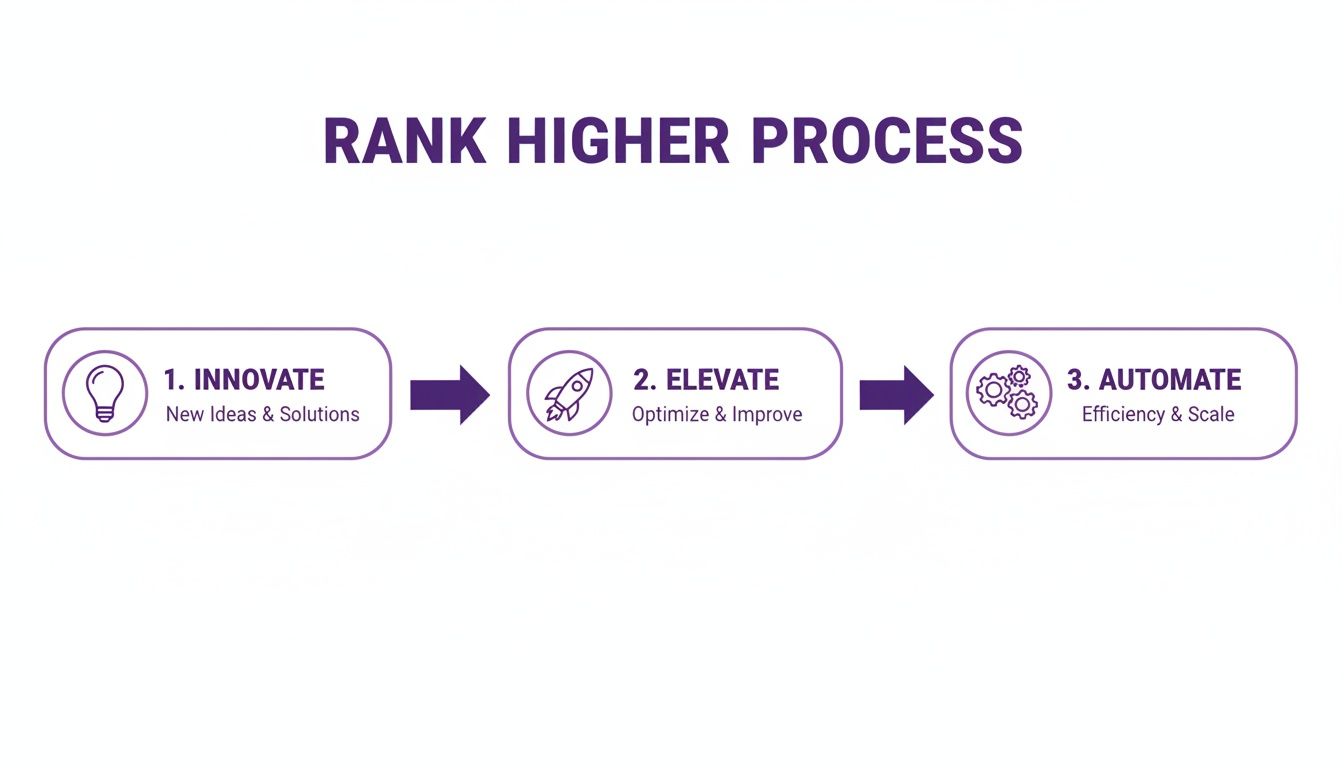
This process demonstrates that real, lasting ranking improvements begin with intelligent strategy, are executed by elevating your digital assets, and are scaled through smart automation.
Here’s a breakdown of what each phase involves:
Innovate: This is the strategic foundation. We conduct a deep-dive analysis of your current digital footprint, market position, and competitive landscape. We identify strategic opportunities—from untapped keywords to operational inefficiencies—to build a data-driven digital transformation roadmap.
Elevate: In this phase, we execute the plan with precision. We enhance every aspect of your online presence. This includes advanced technical SEO, creating content that builds unshakeable authority, optimising your Google Business Profile to win local search, and refining user experience on your WordPress site to convert visitors into leads.
Automate: The final phase is about creating efficiency and scale. We implement intelligent business automations to handle repetitive tasks like lead qualification, appointment scheduling, and client follow-ups. This liberates your team to focus on high-value activities while your digital systems work for you 24/7, ensuring seamless operations and a superior customer experience.
Winning Local Customers with Google Business Profile
For any Australian business serving a specific geographic area—whether you're a plumber in Perth or a law firm in Melbourne—your Google Business Profile (GBP) is your single most powerful tool for attracting ready-to-buy local customers. It's the key to dominating the valuable "map pack" in search results.
Too many business owners treat their GBP as a set-and-forget task, which is a significant missed opportunity. An expertly optimised profile acts as your digital storefront, providing the first and most critical impression to potential customers. It’s where they find your contact details, check opening hours, read reviews, and ultimately decide whether to choose you over a competitor.
The impact of a strong local presence is immense. Research shows that 56% of actions on GBP listings result in a website visit. When you consider that 93% of consumers use online maps to find local businesses, it becomes clear that optimising your profile is non-negotiable for capturing the local market.
Transform Your Profile into a Lead Magnet
Going beyond the basics of your name, address, and phone number is what separates top-ranking businesses from the rest. Your goal is to provide Google and potential customers with as much rich, relevant, and current information as possible.
Think of it this way: every incomplete section of your profile is a missed opportunity to signal your relevance and build trust. A comprehensive profile is a powerful indicator to Google that you’re an active, legitimate, and customer-centric business.
Here’s where to focus your efforts:
- Services and Products: Be specific. An electrician in Brisbane should list services like "switchboard upgrades," "LED lighting installation," and "emergency electrical repairs," not just a generic "electrician." This helps you appear for more detailed, high-intent local searches.
- Business Categories: Select the most accurate primary category, then add all relevant secondary categories. A law firm might choose "Family Lawyer" as its primary but also add "Conveyancing" and "Wills & Estates" to capture a wider, yet still relevant, audience.
- Attributes: Use attributes to highlight key features that matter to your clients, such as "Female-led," "On-site services," or "Online appointments." These details help customers filter results and find the perfect match for their needs.
Engage Actively to Build Trust and Momentum
A static profile quickly becomes invisible. Google rewards businesses that actively engage with customers on the platform, as it signals that your business is open, responsive, and valued by the community.
Your Google Business Profile is a dynamic asset. The more you nurture it with fresh content, customer interactions, and accurate information, the more visibility and trust it will generate for your business.
Two of the most effective ways to maintain this momentum are through Google Posts and the Q&A feature.
Leverage Google Posts for Timely Updates
Think of Google Posts as free, high-visibility micro-advertisements that appear directly on your profile. They are perfect for:
- Showcasing a special offer or promotion.
- Announcing a new service or product launch.
- Sharing photos of a recently completed project.
- Highlighting a recent five-star customer review.
A Sydney-based marketing agency, for example, could create a post promoting a "Free SEO Audit for a Limited Time," driving immediate, high-quality leads directly from the search results page.
Proactively Manage Your Q&A Section
The Questions & Answers section is a goldmine for addressing customer pain points before they even arise. Don't wait for questions to be asked; proactively seed this section with your most frequently asked questions and provide clear, authoritative answers. This positions you as an expert and saves your team valuable time.
You can also use tools like a GBP Optimizer to help manage and enhance your profile for maximum local visibility.
By treating your Google Business Profile as a primary marketing channel, you can significantly boost your local search ranking, attract more qualified leads, and build a stronger connection with your local community. For a deeper dive, our guide on Melbourne local SEO strategies offers more targeted advice.
Building Unshakeable Authority in Your Niche
Simply having a website is no longer enough to be seen on Google. You must prove that you are the definitive answer to your customers' problems. Google's entire algorithm is designed to reward expertise, experience, authority, and trustworthiness (E-E-A-T). Building genuine authority is the core of any sustainable SEO strategy.
Think of it as building a professional reputation. A financial advisor on the Gold Coast who consistently publishes insightful guides on retirement planning becomes the go-to expert in their community. Similarly, a website that comprehensively covers its subject matter becomes the trusted authority online.

This authority is built on two key pillars: demonstrating deep knowledge through topical authority and earning powerful endorsements (backlinks) from other respected online entities.
Mastering Topical Authority Through Content
Topical authority is how you signal to Google that you are a comprehensive resource on a subject. This is achieved not through random blog posts, but by creating a structured web of interconnected content that covers a topic from every conceivable angle.
This strategy involves building "topic clusters." You create a central, in-depth "pillar page" on a broad subject, which is then supported by several specific "cluster" pages that explore related subtopics in detail.
For a Brisbane-based accounting firm, a topic cluster might look like this:
- Pillar Page: The Ultimate Guide to Small Business Tax in Australia.
- Cluster Content: Supporting articles on "Claiming Vehicle Expenses for a Tradie," "Understanding GST Obligations," and "Choosing the Right Business Structure."
This structure sends a powerful signal to Google that you possess deep expertise, making your website a more reliable source of information. The key is creating engaging, ranking content that truly helps your audience.
The Power of High-Quality Backlinks
If your content is your claim to expertise, backlinks are the endorsements that validate it. A backlink is a link from another website to yours. Google interprets these as votes of confidence. The more high-quality "votes" you accumulate, the more credible and authoritative your website becomes.
Crucially, not all backlinks are equal. A single link from a major Australian industry publication is exponentially more valuable than hundreds of links from irrelevant, low-quality blogs. Quality always trumps quantity.
For Australian businesses, from trades to professional services, a strategic, quality-focused link-building strategy is essential for outranking established competitors.
Earning Backlinks the Right Way
Forget risky, outdated tactics like buying links, which can lead to severe penalties. Sustainable link-building is about earning links by creating assets that other websites genuinely want to reference and share.
Here are several ethical strategies that work effectively for Australian businesses:
- Create Link-Worthy Content: Develop original research, comprehensive guides, or insightful case studies that provide unique value. A Sydney-based marketing agency could publish a report on local consumer trends, which business blogs and news outlets would naturally link to.
- Engage in Digital PR: Share your expertise with journalists and industry publications. Providing an expert quote or valuable data point for an article often results in a high-authority backlink.
- Leverage Local Partnerships: Collaborate with complementary local businesses. A Melbourne wedding planner could write a guest post for a local florist's blog, creating a win-win scenario that builds links and reaches a new, relevant audience.
Building true authority is a long-term commitment. By combining deep, topical content with a smart strategy to earn high-quality backlinks, you establish a powerful, defensible position in Google's search results. Understanding Google's quality standards is a key part of this, which we explain in our guide on what E-E-A-T means for your business.
A Technical SEO Health Check for Your Website
Your website’s technical foundation is the bedrock of your entire digital strategy. You can have the most compelling content and authoritative backlinks, but if your site is slow, difficult for search engines to navigate, or insecure, it simply will not rank effectively. Technical excellence is non-negotiable.
Think of it as the structural integrity of your business premises. Customers don't see the foundation, but if it's weak, the entire structure is at risk. A solid technical setup ensures both Google and your users have a seamless, positive experience.
This health check demystifies technical SEO, focusing on actionable advice that delivers the most significant impact for Australian businesses.
Prioritising Core Web Vitals and Site Speed
Page speed is no longer a minor ranking factor; it is a critical component of user experience. Google's Core Web Vitals metrics are designed to measure this experience, focusing on how quickly your page loads, how soon users can interact with it, and its visual stability during loading.
A common cause of slow speeds, particularly on WordPress websites, is large, unoptimised images. Imagine a Perth-based builder showcasing their portfolio with massive, high-resolution image files. This inadvertently slows their site to a crawl, causing potential clients to leave in frustration before ever seeing their quality work.
To resolve this, concentrate on these key areas:
- Image Compression: Use tools to reduce image file sizes without a noticeable loss in quality. This is often the quickest win.
- Efficient Hosting: Invest in a reliable Australian-based hosting provider to ensure faster server response times for your local audience.
- Caching: Implement caching to store static versions of your pages, which dramatically reduces load times for repeat visitors.
A fast, responsive website directly translates to lower bounce rates, higher engagement, and better search rankings. Google rewards sites that prioritise user experience, and speed is a major part of that equation.
Building a Logical and Secure Site Structure
Beyond speed, Google must be able to understand your website's layout. A logical site architecture acts as a clear map, guiding both search engine crawlers and users to the most important content without friction.
This means organising your content into clear categories and using internal links to connect related pages. An accounting firm in Sydney, for instance, should have a clean structure where a main "Services" page links out to specific pages like "Business Tax," "BAS Lodgement," and "Financial Planning." This hierarchy helps distribute authority across your site and makes it easy for Google to understand your areas of expertise.
Security is also paramount. Your website must use HTTPS encryption (indicated by the padlock icon in the browser bar). This protects your visitors' data and is a confirmed ranking signal. Without it, browsers may flag your site as "not secure," instantly eroding trust with potential customers.
For businesses ready to perform a comprehensive audit, our complete technical SEO checklist provides a step-by-step guide to strengthening your site's foundation.
Helping Google Understand Your Content with Structured Data
One of the most powerful yet underutilised tools in technical SEO is structured data (or Schema markup). This is a specialised code added to your website to give search engines explicit, detailed information about your page's content.
Instead of leaving Google to interpret your content, you can spell it out. For a local trade business, you could use schema to specify:
- Your business name, address, and phone number (NAP).
- Your exact opening hours.
- The specific services you offer (e.g., "Plumbing," "Blocked Drains").
- Customer reviews and average ratings.
When Google understands this data, it can display it as "rich results" in the search listings—such as star ratings, opening hours, or event details. These eye-catching snippets significantly increase your click-through rate, driving more qualified traffic to your site even without a change in ranking.
Future-Proofing Your Strategy with AI and Automation
The landscape of search is rapidly evolving. User behaviour is shifting from keyword-based queries to conversational, question-based searches. People expect instant, precise answers. Businesses that adapt to this change will win the future of search.
This evolution is moving beyond traditional SEO into what is now known as Answer Engine Optimisation (AEO).

AEO is the practice of structuring your content to provide direct answers to the specific questions your customers are asking. Mastering AEO positions you to capture high-visibility placements like Google’s featured snippets, voice search results, and the new AI-powered overviews. It’s about becoming the answer, not just another link.
Optimising for Answer Engines
To succeed with AEO, you must adopt your customer's mindset. What specific phrases would they type or speak? A potential client for a Perth law firm isn't just searching "family lawyer"; they are asking, "What are the first steps for a property settlement in WA?"
By creating concise content that directly answers these questions, you signal your authority to Google. This involves rethinking your content structure:
- Use Question-Based Headings: Frame subheadings as the actual questions your audience asks.
- Provide the Answer Immediately: Answer the question directly in the first paragraph, then elaborate further.
- Utilise Structured Data: Use FAQ schema to mark up your question-and-answer content, making it incredibly easy for search engines to identify and feature.
This approach not only helps you rank higher on Google today but also prepares your digital presence for the future of search.
Beyond Search with Business Automation
While optimising for AI in search is crucial, the true transformation occurs when you apply this technology to your internal operations. Intelligent automation can revolutionise how you manage leads, serve customers, and scale your business, creating a powerful competitive advantage.
This is not about replacing people; it's about empowering them. By automating repetitive, low-value administrative tasks, you free up your team to focus on strategic, high-impact work that drives growth. For Australian trades and professional services, this is a game-changer.
Automation is the key to scaling your business without scaling your workload. It builds a smarter, more efficient, and more profitable operation by letting technology handle the routine tasks, so you can focus on the strategic ones.
Imagine an integrated system that handles the grunt work 24/7. This is the practical reality of AI-driven automation. It connects disparate parts of your business, ensuring a seamless experience for both your team and your clients.
A Real-World Automation Example
Consider a plumbing business in Brisbane struggling to manage a high volume of enquiries. The owner spent hours each day on the phone, manually booking jobs and sending reminders, which meant less time on revenue-generating work.
By implementing an automated workflow, they transformed their operations:
- Automated Booking: A customer fills out a form on their WordPress site. The system immediately sends a link to book a time in the calendar, eliminating phone tag.
- Smart Qualification: The system asks qualifying questions (e.g., "Is this an emergency?") and automatically prioritises urgent jobs.
- Automatic Reminders: Both the plumber and the client receive an SMS and email reminder 24 hours before the appointment, significantly reducing no-shows.
- Follow-Up and Review Request: After the job is completed, the system automatically sends the invoice, followed a few days later by a polite request for a Google review.
This single automation sequence saved the business owner over 10 hours of administrative work per week. It also improved customer satisfaction, boosted their positive reviews, and ensured no lead was ever missed. This is the essence of building a smarter, more scalable business.
Answering Your Top Questions About Google Rankings
When it comes to search engine optimisation, questions are inevitable. The path to ranking higher on Google can seem complex, but understanding the fundamentals is the first step towards effective action. This section provides straightforward answers to the most common queries we hear from Australian business owners.

We'll address timelines, the strategic role of content, and the balance between organic and paid search.
How Long Does It Realistically Take to Rank Higher on Google
This is the most frequent question, and the honest answer is: it depends. There is no instant solution for top rankings. The timeline is influenced by your industry's competitiveness, your website's current technical health, and the existing authority of your competitors.
For an Australian business in a less competitive local market—such as a specialised trade in a regional area—positive movement can often be seen within 3 to 4 months of consistent, targeted effort. This initial traction typically appears in local map pack results and for more specific, long-tail keywords.
However, for businesses in highly competitive national markets, like a financial services firm in Sydney, achieving stable page-one rankings is a longer-term investment. A realistic timeframe is generally 6 to 12 months of dedicated work on technical SEO, content creation, and authority building.
The key takeaway is that SEO is a long-term investment in a valuable business asset. Success is achieved through consistent, strategic action, not short-term tactics.
Do I Really Need a Blog for My Business Website
Yes, but it's time to reframe what a "blog" means in 2024. Think of it less as a diary and more as a strategic resource hub. This is your primary platform for demonstrating expertise and building the topical authority that Google rewards.
Consistently publishing high-quality, helpful content that directly answers your customers' questions is one of the most powerful SEO strategies available. It achieves several critical business objectives simultaneously:
- Builds Topical Authority: It proves to Google that you are a comprehensive expert in your niche.
- Attracts Backlinks: Genuinely valuable guides and articles naturally earn links from other reputable websites.
- Targets Long-Tail Keywords: It allows you to capture traffic from the specific, detailed questions your potential customers are searching for daily.
For example, a Brisbane-based accounting firm that regularly publishes in-depth guides on "BAS lodgement for sole traders" or "tax deductions for construction businesses" is actively proving its expertise. This content becomes a lasting asset that attracts qualified traffic and builds client trust for years.
Is It Better to Focus on SEO or Paid Google Ads
For most Australian businesses, an integrated strategy that utilises both SEO and paid ads is the most effective approach. They serve different but complementary purposes to maximise visibility and lead generation. It’s not a question of "either/or," but rather "how and when" to deploy each channel.
Here’s a simple breakdown of their roles:
| Strategy | Primary Goal | Timeline | Key Benefit |
|---|---|---|---|
| SEO | Sustainable organic growth | Long-term (6-12+ months) | Builds a lasting digital asset that generates compounding "free" traffic over time. |
| Google Ads | Immediate traffic & leads | Instant (once active) | Delivers quick results, ideal for testing offers and validating market demand. |
Google Ads can provide immediate data and revenue, which is invaluable for a new business or when launching a new service. The insights from your ad campaigns—such as which keywords have the highest conversion rates—can then inform your long-term SEO strategy. Concurrently, a strong organic presence built through SEO can improve your ad Quality Score, potentially lowering your cost per click. Together, they create a powerful, synergistic growth engine.
Ready to stop guessing and start dominating? The team at DigitUX specialises in creating comprehensive digital transformation strategies that deliver measurable results for Australian businesses. Book a discovery call today to learn how we can build your blueprint for sustainable growth and operational excellence.