

For Australian small business owners, the daily grind is real. You're juggling customer service, managing projects, and trying to find new leads, all with a finite amount of time and an even tighter budget. This is where marketing automation comes in—think of it as your most valuable employee, working 24/7 to capture leads, nurture relationships, and ensure no opportunity ever slips through the cracks. It's a cornerstone of digital transformation, designed to boost your efficiency and online visibility.
Why Your Business Can No Longer Ignore Automation
If you feel like you're constantly playing catch-up, you're not alone. The pressure to maintain a strong online presence, follow up with every enquiry, and deliver exceptional service can be overwhelming. This is where marketing automation for small business stops being a luxury and becomes fundamental to your survival and growth.
This guide is your practical roadmap to shifting your operations from reactive to proactive. We'll show you how accessible tools and AI-driven strategies can level the playing field, allowing local trades, professional services, and ambitious growth-focused businesses across Australia to compete and win.
The Shift Towards Smarter Operations
The move towards automation is no longer a trend reserved for large corporations. It’s a strategic necessity, driven by the need to work smarter, not harder. By 2026, a staggering 80% of Australian SMEs will see marketing automation as critical for driving sustainable growth. Businesses already on board are reporting an average efficiency boost of over 30%, freeing up their teams to focus on what truly matters—building client relationships and delivering quality service.
This isn't just about scheduling a few emails. It’s about creating intelligent, interconnected systems that deliver measurable business benefits:
- Massive Efficiency Gains: Put repetitive tasks like data entry, social media posting, and email follow-ups on autopilot. Imagine what you could do with those hours back each week.
- Leak-Proof Lead Generation: Automatically capture and qualify leads from your website, Google Business Profile, or paid ads, ensuring no potential customer is ever missed.
- A Better Customer Experience: Deliver consistent, personalised communication at every stage of the customer journey, from first contact to post-sale follow-up.
- True Scalability: Build a foundation that supports business growth without needing to proportionally increase your manual workload or headcount.
At DigitUX, we specialise in implementing these systems as part of a holistic digital transformation strategy. We believe true growth comes from making smart technology work for you. To see just how powerful this shift can be, explore the rise of business automation and why it's crucial for growth.
How Marketing Automation Actually Works
Let's cut through the technical jargon. At its core, marketing automation is a system that handles the repetitive, time-consuming marketing jobs on your to-do list. This frees you up to connect with more customers in a more personal way, without being glued to your phone or computer all day.
Think of it as the most diligent virtual assistant you could ever hire. It works 24/7, following a clear set of rules—or 'workflows'—that you set up once. These rules are activated based on a customer's action, like downloading a guide from your website, clicking a link in an email, or visiting your pricing page.
The Engine Room of Automation
This process isn't random; it's a structured system built on a few key components that work together. Understanding these building blocks is the first step to seeing how marketing automation for small business can completely transform your operations.
The entire system runs on three core concepts:
- Triggers: The 'if this happens…' part of the equation. It's an action a customer takes. For a Perth-based electrical contractor, a trigger might be someone filling out their 'Request a Quote' form on their WordPress website.
- Actions: The '…then do that' automated response. Following our electrician's example, the action would be to instantly send a confirmation email and add that person to a 'New Leads' list in their system.
- Workflows: The sequence of triggers and actions you map out. It’s the strategic game plan that guides a customer from their first enquiry all the way to a sale and beyond, all without you lifting a finger.
Essentially, you're building a digital customer journey. By automating touchpoints, you ensure every lead receives a consistent, timely, and relevant experience—something almost impossible to manage manually as your business grows.
From Manual Chaos to Automated Clarity
To grasp the power of this shift, picture the difference between the old way and the new, automated way. Manually juggling leads often means messy spreadsheets, follow-ups that fall through the cracks, and inconsistent messaging.
Automation organises the entire process into a neat, efficient, and measurable system. It's the difference between structured growth and just being busy.
Manual Marketing vs. Automated Marketing Workflows
The table below breaks down the before-and-after, showing how much time and effort you save when you let a system handle the heavy lifting.
| Marketing Task | Manual Approach (The Old Way) | Automated Approach (The Smart Way) |
|---|---|---|
| New Lead Follow-Up | Remembering to email each new contact individually, often with delays. | An instant, personalised welcome email is sent the moment a lead signs up. |
| Lead Nurturing | Sending sporadic, generic email blasts to your entire contact list. | A tailored sequence of emails is sent based on the lead's specific interests and online behaviour. |
| Sales Handoff | Manually notifying the sales team about a promising lead via email or phone. | Automatically assigns the hot lead to a salesperson and schedules a task in the CRM. |
The automated approach isn't just about saving time; it's about creating a superior and more reliable experience for your potential customers, which is what builds trust and drives sales.
The Real ROI of Automating Your Marketing
So, beyond saving a few hours a week, what’s the real, measurable impact of marketing automation for a small business? The true value isn't just about doing things faster; it's a strategic investment that directly improves your bottom line through better leads, lower customer acquisition costs, and higher conversion rates.
This isn't just theory. For Australian businesses, the financial returns are tangible and proven. Automation builds predictable, scalable growth, turning your marketing from a business expense into a reliable revenue-generating machine.
Turning Features into Financial Wins
Think of it this way: every automated workflow is designed to nudge a potential customer closer to a sale. This creates a powerful flywheel effect where your initial investment compounds into significant long-term gains.
Here’s where the money is really made:
- Higher Lead Conversion Rates: By nurturing leads with timely, relevant information, you build trust and stay top-of-mind. This means more of your hard-won leads become paying customers.
- Lower Customer Acquisition Costs (CAC): Automation allows you to qualify and warm up leads systematically. This reduces the manual effort and ad spend (from Google or Meta ads) needed to land a new client. You simply spend less to get more.
- Increased Customer Lifetime Value (LTV): Automated follow-ups, special offers for loyal customers, and review requests keep people engaged long after the first purchase, encouraging repeat business and referrals.
- A Predictable Sales Pipeline: With a clear view of your lead flow and conversion numbers, you can forecast revenue with far more accuracy, leading to smarter decisions about future growth.
This flow diagram breaks down the core process, showing how automation systematically turns a flicker of interest into actual revenue.
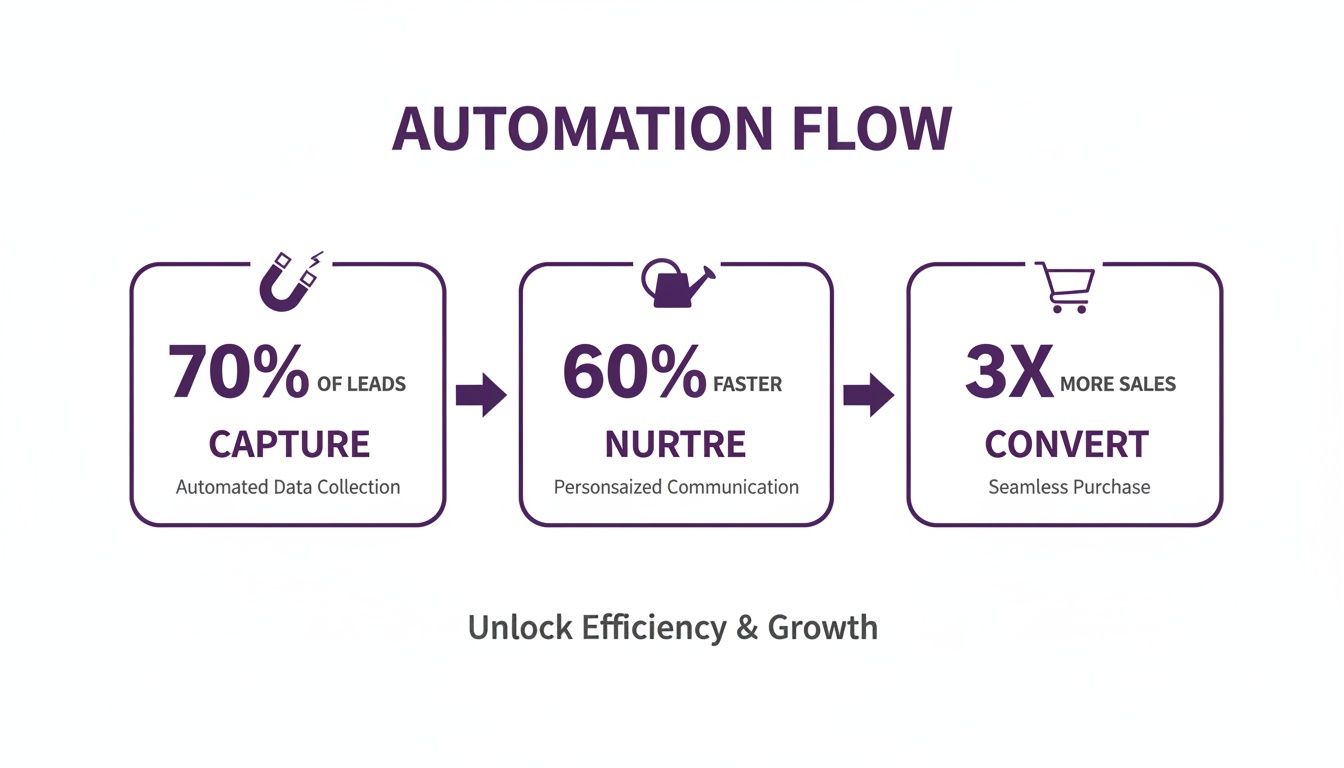
Each stage works together, ensuring no lead falls through the cracks and you get the maximum return on your marketing investment.
The Numbers Speak for Themselves
The financial case for automation is incredibly strong, with local data to back it up. Whether you're a plumber in Perth or a consultant in Sydney, the goal is the same: turn online visibility into profitable work.
For a small business, marketing automation acts as your best salesperson—one that never sleeps, never forgets to follow up, and works tirelessly to filter out tyre-kickers, presenting you only with sales-ready opportunities.
The results are impressive. Recent figures show that Australian small businesses using AI-powered marketing automation are seeing an average ROI of 340% within just 18 months. At the same time, they're slashing customer acquisition costs by up to 48%.
In plain terms, for every $1 you invest, automation can return an average of $5.44.
Automation Workflows You Can Implement Today
Theory is one thing, but seeing marketing automation for a small business in action is where the real value becomes clear. Below are three practical, powerful workflows designed specifically for Australian service businesses. Think of them as ready-to-go blueprints you can adapt to start seeing an immediate lift in efficiency and leads.
These are not complex, enterprise-level systems. They are achievable, high-impact sequences built to solve the everyday challenges faced by Australian SMBs—from capturing new leads to delighting existing customers.
Workflow 1: Lead Magnet and Nurture
This is the classic starting point because it works—it turns anonymous website visitors into engaged, sales-ready leads. It's perfect for any professional service, like a Melbourne accounting firm providing a "Small Business Tax Checklist".
Here’s how it works:
- Capture: A visitor lands on your site and enters their email address to download your free checklist.
- Deliver & Tag: The system instantly emails them the download link and tags them in your CRM as a "New Lead – Tax Checklist".
- Nurture: Over the next few weeks, a pre-written series of three emails is sent automatically. The first might share a related blog post, the second a case study, and the third an invitation for a free consultation.
This simple sequence educates your prospect and builds trust on autopilot, warming them up for a sales conversation without your team lifting a finger.
Workflow 2: The Hot Lead Handoff
This workflow ensures your most valuable, high-intent leads get an immediate response, dramatically increasing your chances of closing the deal. Imagine a commercial builder in Sydney whose ideal client has just spent time on their "Project Gallery" and "Pricing" pages.
Here’s the process:
- Identify: Your automation software monitors a contact’s website activity. When they visit key sales pages, they’re assigned a high lead score.
- Alert: The system instantly sends an internal notification to your sales manager with the lead’s details and browsing history.
- Action: Simultaneously, it creates a task in your CRM for the sales manager to call that prospect within the hour.
This removes guesswork and delay, empowering your team to engage with prospects at the exact moment they’re most interested.
Workflow 3: Customer Loyalty and Reviews
What you do after the sale is critical for creating loyal customers who become your best advocates. This workflow is a must-have for a trades business, like a Brisbane-based plumber, right after they’ve finished a job.
- Onboarding: The day after the job is marked 'complete' in your system, an automated "Thank You" email is sent. It might include a link to care instructions or warranty details.
- Feedback Request: Seven days later, a second email goes out asking for feedback and inviting them to leave a Google review with a direct link.
- Future Engagement: That customer is then added to a "Happy Customers" list for future marketing, such as seasonal maintenance reminders or automated push notifications for special offers.
This process not only makes customers feel valued but also systematically builds your online reputation through a steady stream of positive reviews.
The financial upside here is significant. For every dollar put into marketing automation, Australian small businesses see an average return of $5.44, with a massive 76% of businesses reporting a positive ROI within the first year.
Connecting Automation with Your Existing Tools
One of the biggest myths about marketing automation for a small business is that you need to discard your current tools. The reality is that a good automation platform doesn’t replace your tools—it connects them.
Think of it as the central nervous system for your digital operations. It allows your website, Customer Relationship Manager (CRM), and email marketing software to communicate, sharing data in real-time. Suddenly, those disconnected silos work together, giving you a unified view of your customer that enables smarter decisions.
Creating a Cohesive Digital Ecosystem
For most Australian businesses, a high-performance WordPress website is the heart of their online presence. Marketing automation plugs directly into it, transforming your site from a static brochure into a dynamic lead-generation machine.
This connection allows you to:
- Capture Leads Directly: When someone fills out a contact form, that lead can flow straight into your automated workflows. No more manual data entry.
- Track User Behaviour: See which pages a prospect visits and what they click on. This isn't just data; it's the trigger for genuinely personalised follow-ups.
- Maximise SEO and Paid Ad ROI: When you drive traffic to your site with SEO or Google Ads, automation captures and converts those visitors, ensuring you get the best possible return on your investment.
The Power of a 360-Degree Customer View
Things get really powerful when you link your automation platform to your CRM. Every interaction—a website enquiry, a sales call, an email they opened—lives in one synchronised place.
This unified view is the secret to true personalisation. It stops you from sending generic, one-size-fits-all messages and allows you to communicate with people based on their actual relationship with your brand.
For a Brisbane-based trade business, this could be as simple as an automated email asking for feedback the moment a job is marked ‘complete’ in their CRM. This single action can dramatically increase positive reviews. In fact, learning how to get more Google reviews is a brilliant way to use this connected system to build your online reputation and authority on autopilot.
Your Roadmap to Getting Started With Automation
Ready to implement marketing automation? Let's walk through a clear, step-by-step plan to get you started on the right foot, without the overwhelm. The key is to begin with small, high-impact tasks that deliver value immediately, building momentum as you go.
Start with the basics. Don't try to automate everything at once—that’s a classic mistake. Instead, focus on a quick win, like setting up an automated welcome email for new contacts who fill out a form on your WordPress website. This single action ensures every new lead gets an immediate, professional reply, instantly lifting their experience with your brand.
Finding the Right Tools and Foundation
Choosing the right software is a critical next step. Look for platforms built for small businesses, with scalable pricing and a user-friendly interface. Key features to prioritise are a simple workflow builder, easy integration with your website, and solid email marketing tools.
But before you start, ensure your digital foundation is secure. Implementing essential WordPress security best practices is a non-negotiable step to protect your data and your customers' information.
The most successful automation strategies are built on a solid, secure foundation. Prioritise a simple, effective workflow over a complex one that never gets launched. Action beats perfection every time.
Taking the Next Step
Once your first workflow is running smoothly, you can explore more advanced sequences like lead nurturing campaigns or automated review requests. The confidence gained from that first success makes these next steps feel much more manageable.
Of course, building a truly powerful strategy that integrates with your entire business operation takes a deeper level of expertise. When you're ready to move beyond the basics and unlock what automation can truly do for your growth, our team is here to help.
At DigitUX, we are Digital Transformation Specialists who can guide you from that first simple setup to full-scale business process optimisation.
Got Questions? We've Got Answers
Stepping into the world of marketing automation can feel like a big move, especially for a small business. It's natural to have questions. We hear many of the same ones from Australian business owners, so we've answered the most common ones here.
Is Marketing Automation Just for Big Companies?
Not at all. While enterprise platforms can be expensive, there are many affordable, scalable tools built specifically for SMBs, with some starting from just $40-$50 AUD a month. The real question isn't about cost, but about return on investment. With an average return of $5.44 for every $1 spent, automation is one of the most cost-effective ways to drive sustainable growth.
Won't This Make My Marketing Feel Robotic and Impersonal?
This is the biggest myth out there. When done right, automation makes your marketing more personal and timely than you could ever manage manually. By tracking a customer's online behaviour, you can send them relevant messages that resonate.
The goal isn't to replace the human touch. It's to automate repetitive tasks, freeing you and your team up to have high-value conversations with your most engaged leads and customers.
Do I Need to Be a Tech Whiz to Get This Set Up?
Honestly, no. Modern automation platforms are designed to be user-friendly. Most feature intuitive drag-and-drop builders and ready-made templates for common workflows, so you don't need to be a developer to get started. A basic understanding of digital marketing is useful, but the initial setup is straightforward. For advanced integrations and strategy, partnering with a specialist can help you maximise the platform's potential and align it perfectly with your business goals.
Ready to see how intelligent automation and a clear digital transformation strategy can bring predictable growth to your business? As Digital Transformation Specialists, the team at DigitUX is here to guide you.