


The way your Australian customers find you online has changed forever. The traditional list of ten blue links is being replaced by direct AI answers and summaries, which fundamentally alters how you earn visibility. For your business, this means simply ranking is no longer enough; you have to become the answer itself.
This shift presents a challenge for many businesses still relying on outdated SEO tactics. If your online presence isn't optimised for how AI understands and recommends solutions, you risk becoming invisible to a growing segment of high-intent customers. At DigitUX, we specialise in digital transformation strategies that turn this challenge into a powerful growth opportunity.
The New Search Revolution in Australia
Think of old-school SEO as getting your business listed in the phone book. Your main goal was just to be on the right page, under the right heading. This new reality, dominated by AI-powered search, is more like having the phone operator personally recommend your service when a customer calls for help. This is the core of Answer Engine Optimisation (AEO), and it’s a critical shift for every Australian business.
This isn't a future prediction—it's happening right now. When a potential client in Sydney searches for "best commercial electrician," they're no longer just getting a list of websites to sift through. Instead, Google often presents a generated summary of top providers, complete with key details explaining why they are recommended. If your business isn't optimised to be understood by AI, you simply won't make that list.
This transformation is fuelled by massive tech investment and adoption right here in Australia. A recent survey revealed that nearly half of all employed Australians already use generative AI. For businesses, this proves AI isn't just a buzzword; it's a core operational reality turning visibility in ai answers into measurable revenue and enhanced business efficiency.
From Keywords to Conversations
The old SEO model was all about keywords. You'd find terms like "plumber Brisbane" and work tirelessly to get your page to the top for that phrase. The new model is conversational and driven by intent. It’s about answering the full context of a customer’s problem, which might look something like this:
- "Which local plumber offers 24/7 emergency services near me?"
- "What are the benefits of hiring a Xero-certified accountant for a small business?"
- "How much does it cost to get a WordPress site redesigned in Melbourne?"
Answer Engine Optimisation is about structuring your digital presence so that AI models recognise your business as the most authoritative, trustworthy, and relevant solution to these specific questions. It moves the goal from ranking for a keyword to becoming the definitive source of the answer.
This shift presents a huge opportunity. By aligning your digital strategy with how AI actually works, you can capture high-intent customers at the exact moment they need you. To get a deeper handle on this change, it's worth exploring how Google’s AI Overviews are changing everything for Australian businesses. This is the new frontier of digital visibility.
How AI Answers Actually Work
To dominate this new search landscape, you need to understand how the engine works. Let's break down how AI answers are created, as it’s a significant leap from traditional information retrieval.
Think of traditional search as a librarian handing you a catalogue of books. You get a list of links, but you still have to go through them yourself to find the answer. An AI answer engine is more like a librarian who has already read every book, understood all the content, and gives you a direct, synthesised summary of exactly what you need to know.
This image shows the fundamental shift from the old lists of links to this new era of AI-powered, direct answers.
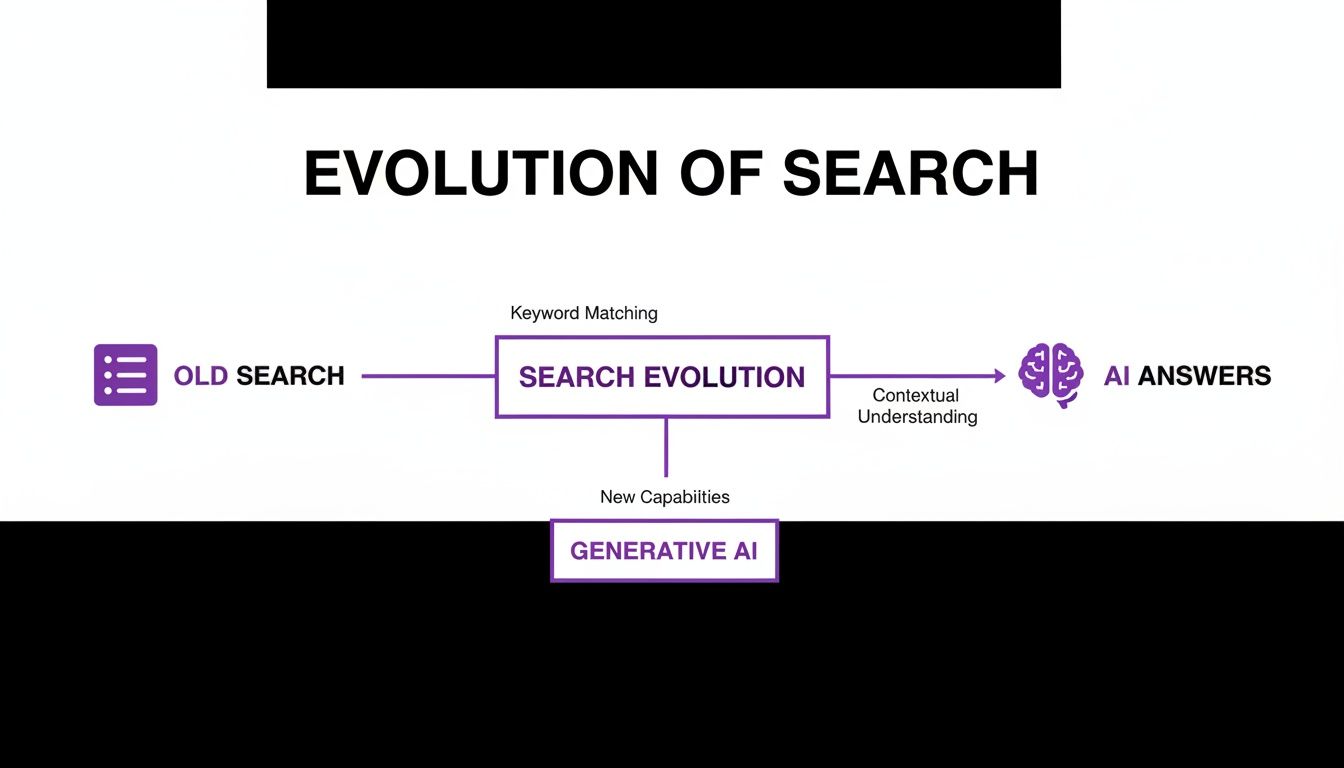
The main takeaway? Search is moving from a passive index of information to an active intelligence that does the heavy lifting for the user. Your goal is no longer just to be on the list of books; it's to be the trusted source material the AI uses to write its summary.
The Engine Behind The Answer
At the core of this technology are Large Language Models (LLMs), the sophisticated AI systems powering generative search. These models have been trained on staggering amounts of text and code from across the web. This allows them to grasp context, nuance, and the relationships between topics in a way older technologies simply couldn't.
When someone asks a question, the answer engine doesn’t just scan for keywords anymore. It uses its LLM to figure out the intent behind the query. It then checks this intent against its own massive, structured database of verified information, which Google calls the Knowledge Graph.
The Knowledge Graph is essentially Google's brain. It's an enormous web of interconnected facts about people, places, and things—or "entities." For your business to show up in an AI answer, Google has to understand what your business is, what it does, and why it's a trustworthy entity in its field.
This whole process is about establishing authority. The AI pieces together information from multiple authoritative online sources to build a coherent, reliable response. Understanding these intricate processes means looking into how specialised AI, like question answering AI, can unlock instant answers by processing huge datasets.
From Data to Authority
For your Australian business, this means becoming a recognised authority is no longer optional—it's everything. The AI is constantly looking for signals that prove your expertise.
Key signals include:
- Structured Data: Using Schema markup on your WordPress site to explicitly tell Google you're a local business, what services you offer, and where you're located.
- Topical Relevance: Creating comprehensive content that thoroughly answers the questions your real customers are asking.
- Authoritativeness: Gathering positive reviews, getting mentions from other reputable local sites, and keeping a complete and active Google Business Profile.
While Australian organisations are adopting AI quickly, there's a big gap between trying it and getting results. Many businesses find their data is too fragmented to deliver the expected ROI. This is exactly why a structured digital transformation strategy like Answer Engine Optimisation (AEO) is so critical. It ensures your efforts lead to real business outcomes, such as improved visibility and lead generation, not just unfulfilled hype.
Ultimately, getting featured in AI answers isn't about a clever keyword trick. It's about building a digital footprint that proves to Google that you are the definitive, trustworthy answer for your specific industry in your local area. This is the foundation of any modern digital strategy.
Why Your Business Cannot Afford to Ignore AEO
Understanding how AI generates answers is one thing. Realising the direct impact on your business’s bottom line is another. For Australian businesses, especially in professional services and trades, ignoring Answer Engine Optimisation (AEO) is no longer a viable option. It's fast becoming the difference between being recommended by AI and being completely invisible.
Imagine a potential client searching for "best commercial electrician in Brisbane." Instead of just a list of links, they now get a direct, AI-generated summary of the top local providers. If your business isn't structured in a way the AI can understand and trust, you simply won't make that list—no matter how high your traditional SEO rankings are. This is where AEO becomes non-negotiable for business scalability.
Capture High-Intent Leads Automatically
AEO positions your business to meet customers at the absolute peak of their buying intent. When someone asks a specific question like, "Which Melbourne law firm specialises in commercial leases?", they aren't just browsing. They have an urgent, specific need. By optimising your content to answer these queries directly, you place your business right in their path.
This translates directly to more qualified leads because the AI has already pre-vetted your business as a relevant solution. You’re not just another link in a long list; you are the answer.
A strong AEO strategy builds automatic trust. When an AI engine like Google's presents your business as an authoritative source, it provides a powerful third-party endorsement that you simply can't buy.
Build Sustainable, Compounding Growth
The benefits of AEO compound over time. Every piece of content you create that answers a customer question, every snippet of structured data you add to your WordPress site, and every positive review you get builds your brand’s "entity" authority in Google's eyes.
Think about it in practical, Australian terms:
- For a Sydney plumbing service: Optimising for queries like "cost to fix a leaking tap in the Eastern Suburbs" can lead to direct, high-value job bookings. This boosts efficiency and lead generation.
- For a Brisbane-based financial advisor: Answering questions about "SMSF setup for small business owners" establishes deep expertise and attracts premium clients, driving scalability.
This strategy delivers sustainable growth that doesn't rely solely on expensive paid ad campaigns. Your authority becomes a durable asset that continuously generates leads. To get a handle on what this means for your strategy, A Guide to Answer Engine Optimization is an essential read.
Your Competitors Are Already Moving
The ground is shifting quickly. Your competitors are already using AI to get ahead, making AEO crucial for holding onto your market share. As we explain in our guide on the differences between SEO, AEO and GEO, this isn't about throwing out your existing efforts. It's about enhancing them for the new reality of search.
The choice is simple: adapt now, or risk being left behind as your competitors become the default ai answers in your industry.
Your Action Plan for Dominating AI Answers
You understand the 'what' and 'why' behind AI answers. Now for the 'how'. This is your actionable roadmap to not just show up in AI-powered search, but to own it. Forget searching for a magic bullet; this is about building a rock-solid foundation that makes your business the only logical, authoritative choice for an AI to recommend.
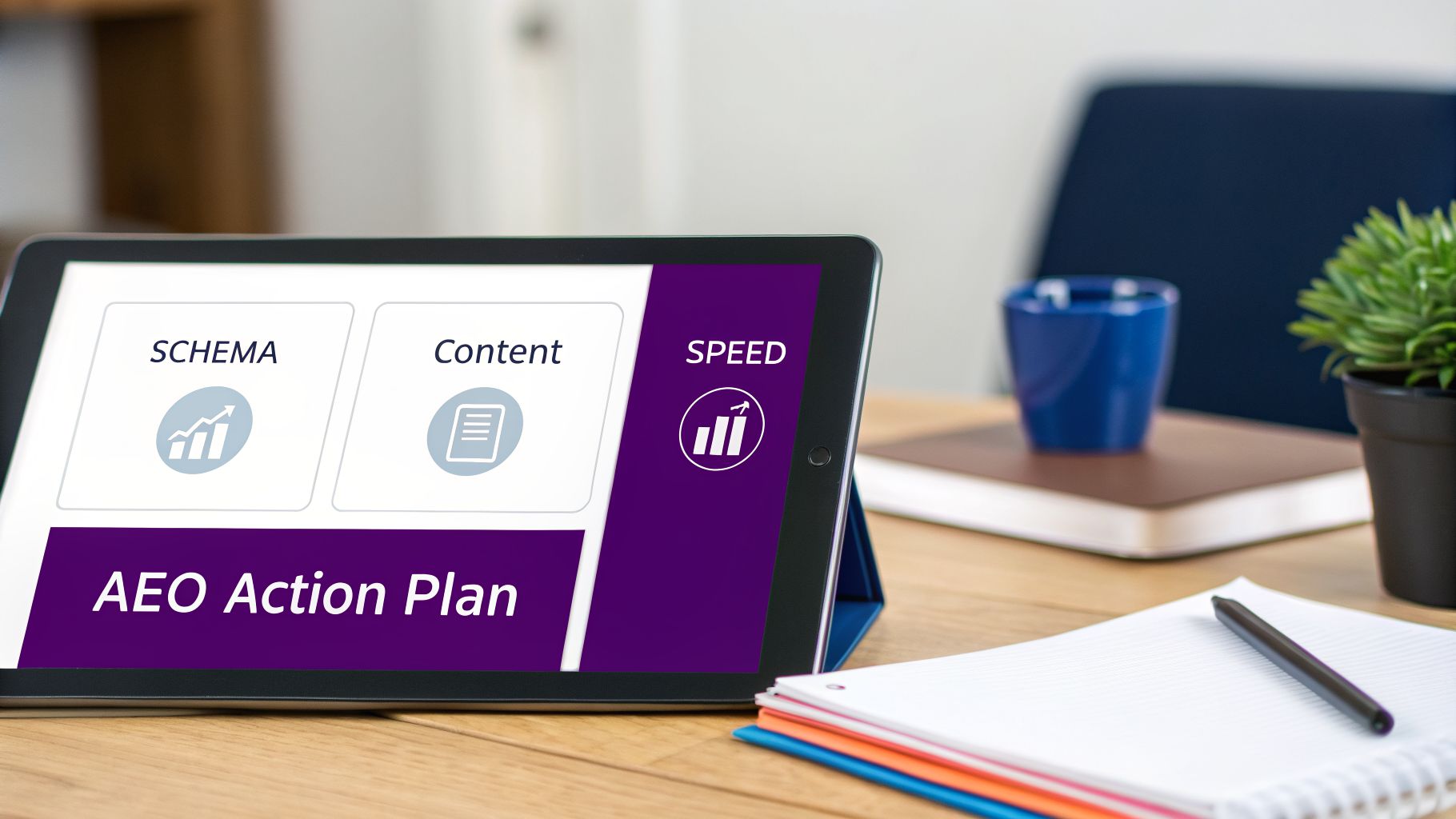
We'll break this down into clear, manageable steps. By focusing on these core areas, you can strategically position your Australian business to pull in high-value traffic from the next wave of search.
Step 1: Solidify Your Technical Foundations
Before you can become the star of the show, you need a solid stage. AI engines favour websites that provide a flawless user experience, as it’s a massive signal of quality and reliability. If your site is slow or messy on mobile, you’ll be filtered out before you even get a look-in.
Your first job is to nail the basics of WordPress performance and design:
- Site Speed: AI systems, just like impatient customers, hate slow-loading pages. A laggy website is a dead end. Use tools like Google PageSpeed Insights to see what’s slowing down your WordPress site and get it fixed.
- Mobile Experience: The majority of searches happen on phones. Your website absolutely must be responsive and a breeze to use on a small screen. If text is tiny or buttons are impossible to tap, you're losing both people and AI favour.
- Crawlability: Ensure search engines can easily crawl and understand all important content on your site. This boils down to a clean site structure and a properly configured
robots.txtfile.
Think of these technical elements as the cost of entry. Without them, even the most brilliant content strategy for AI answers will fall flat.
Step 2: Master Advanced Schema Markup
Schema markup is code you add to your website to explicitly tell search engines what your content is about. It’s like adding descriptive labels to your information, turning vague text into crystal-clear, machine-readable data. While basic Schema (like LocalBusiness) is a decent start, owning AI answers requires going much deeper.
Schema is the closest thing we have to a direct line of communication with search engine AI. It removes guesswork, allowing you to define your business, services, location, and expertise with absolute clarity.
For an Australian service business, this means getting specific with your Schema types.
- For a Trade Business: Use
Electrician,Plumber, orHVACBusinessmarkup. Also, useServiceschema to detail specific offerings like "24/7 emergency call-outs" or "hot water system installation," including your service area and pricing where possible. - For a Professional Service: Implement
ProfessionalServicealong with more niche types likeLegalServiceorFinancialService. For individual practitioners,Personschema is perfect for establishing the expertise and authority of your key team members. - For All Businesses:
FAQPageschema for your question-and-answer pages andReviewschema to showcase social proof are incredibly powerful. They’re practically designed for getting featured.
You can streamline this on a WordPress site with plugins like Yoast SEO or Rank Math, but a custom implementation from a digital transformation specialist will often get you the best, most precise results for your specific business.
Step 3: Build Your Authority in the Knowledge Graph
Google’s Knowledge Graph is its brain—a massive database of interconnected facts about entities (people, places, organisations). To become the source for an AI answer, your business needs to be a prominent and trusted entity within this graph.
Your Google Business Profile (GBP) is your most direct way to influence this. It's not just a local listing anymore; it’s the central hub for your business's entity information.
- Complete Every Section: Fill out every single field with detailed, accurate, and consistent information. This means services, business hours, and precise location data. Don't be lazy here.
- Encourage and Respond to Reviews: A steady stream of positive reviews is one of the strongest signals of authority and trust. Just as importantly, always respond to reviews (good and bad) to show you are engaged and you care.
- Use Google Posts and Q&A: Regularly share updates, offers, and answer questions directly on your profile. This feeds the AI fresh, relevant content about what your business is doing right now.
Beyond your GBP, building authority also means getting mentions from other reputable local websites, like industry associations or local business directories. Every quality citation reinforces to Google that your business is a legitimate and important player in the local community.
Step 4: Structure Content to Answer Questions Directly
AI is built to find direct answers to specific questions. This means your content strategy needs to shift—move away from targeting broad keywords and start providing explicit answers to the problems your customers have.
Structure your website content into clear, logical chunks that an AI can easily pull apart and reuse.
- Use Question-Based Headings: Instead of a generic heading like "Our Services," get specific with question-based H2s and H3s. Think "What Are the Signs of a Failing Hot Water System?" or "How Often Should I Service My Air Conditioner in Perth?".
- Create Dedicated FAQ Pages: Build out comprehensive FAQ pages that address the most common questions your customers ask. This is low-hanging fruit for capturing AI answers and zero-click searches.
- Use Lists and Tables: Break down complex information into bulleted lists, numbered steps, or comparison tables. This modular format is perfect for an AI to lift directly into a search result. For instance, a table comparing "Ducted vs. Split System Air Conditioning" is highly 'snippable' content.
When you adopt this question-and-answer framework across your site, you turn your content from a simple brochure into a valuable resource that both customers and AI will turn to for reliable information. This is the blueprint for becoming the go-to authority in your field.
Connect AI Answers with Business Automation
Attracting high-quality leads with Answer Engine Optimisation (AEO) is a massive step forward, but it's only half the journey. Real business growth kicks in when you efficiently turn that hard-won visibility into measurable revenue. This is where you connect the dots between being found through ai answers and achieving true operational excellence through business automations.

Picture this: a lead comes through your WordPress site after finding your business in an AI-generated answer. Instead of that lead sitting in an inbox waiting for someone to act, an automated system gets to work instantly. This creates a seamless, scalable system that turns increased visibility into tangible results with minimal human effort, improving your lead conversion strategies.
From First Click to Converted Client
The goal is to build a frictionless path from that initial enquiry to a paying customer. Automation is the bridge that makes this possible, ensuring no opportunity falls through the cracks. It’s all about creating a responsive and professional experience that impresses potential clients from the very first interaction.
Here’s how a simple lead automation workflow might look:
- Step 1: Instant Capture: A potential client fills out a contact form on your website. The system immediately captures their details.
- Step 2: Smart Routing: The information is automatically added to your Customer Relationship Management (CRM) system.
- Step 3: Personalised Engagement: A personalised welcome email is instantly sent to the lead, thanking them for their enquiry and setting expectations.
- Step 4: Team Notification: At the same time, your sales team or the right staff member gets a notification with all the lead's details, prompting them to follow up.
This process transforms a passive enquiry into an active sales opportunity in seconds, not hours or days. It dramatically shortens your lead response time—a critical factor in converting modern customers who expect immediate engagement.
A Real-World Automation Scenario
Let’s take a trade business—say, a Perth-based air conditioning installation company—that has successfully optimised for ai answers. They now appear for queries like, "What's the best ducted aircon system for a two-storey home?"
A homeowner, impressed by the AI's recommendation, clicks through to their site and requests a quote. This is where automation takes over.
- Inquiry Received: The quote request form triggers an automation sequence.
- Instant Scheduling Link: The system sends an immediate email and SMS to the lead with a link to the technician's calendar to book a site inspection. This puts the power in the customer's hands and eliminates frustrating phone tag.
- CRM Update: The lead’s status in the CRM is updated to "Quote Scheduled," and the appointment is automatically added to the technician's calendar.
- Follow-Up & Reminders: The system schedules automated reminders for both the client and the technician leading up to the appointment.
This hands-off process not only saves a huge amount of administrative time but also boosts the quote-to-job conversion rate substantially. By providing a fast, professional, and organised experience, the business builds trust and secures the job before competitors have even replied. This is just one of many business process automation benefits that can supercharge your growth.
How to Measure Your AEO Success
In the world of AI answers, the old scoreboard doesn't quite work anymore. When success isn't just about getting someone to click on your website, how do you actually know if your Answer Engine Optimisation (AEO) efforts are paying off? The key is to shift your focus from traditional vanity metrics to new Key Performance Indicators (KPIs) that prove you're becoming an authority.
It means looking past click-through rates and focusing on how often your brand is the source of the answer. It’s about measuring the direct, high-quality leads that come from being seen as the expert and showing a clear return on investment for your Australian business.
Key Performance Indicators for the AI Era
To properly gauge your AEO performance, you need a new set of metrics. These KPIs are less about how much traffic you get and more about the quality and type of visibility you're earning. They help you figure out if you're successfully becoming the go-to source in your niche.
Start keeping an eye on these crucial indicators:
- Growth in Brand Impressions for Questions: Jump into tools like Google Search Console and watch your impressions for long-tail, question-based searches (e.g., "how much to install a new hot water system in Brisbane"). A steady climb here is a great sign that Google sees your content as a credible answer.
- Increased "Zero-Click" Visibility: Showing up in an AI Overview or a featured snippet means the user got what they needed without even visiting your site. It sounds counter-intuitive, but this is a massive win for your authority. Tracking how often you appear in these spots is a direct measure of your AEO success.
- Rise in Direct and High-Quality Leads: As your AEO strategy takes hold, you should notice a definite improvement in your leads. These prospects are often better informed and much closer to making a decision because the AI has already positioned you as the expert they need.
Using Google Search Console to Spot AEO Wins
Google Search Console (GSC) is your best friend when it comes to measuring the impact of optimising for ai answers. It gives you a direct look at how your site is performing for the exact kinds of queries that trigger AI-generated results.
Don’t just look at clicks. Filter your GSC performance report by queries containing words like "how," "what," "why," and "cost." A high number of impressions with a low click-through rate in this segment is often a strong indicator that you are being featured in "zero-click" search results, which is a significant AEO victory.
This is the data that proves your strategy is working. It shows that even without a direct click, your brand is capturing valuable mindshare and building trust at the most critical moment—when a potential customer asks a question.
Got Questions About AEO? We've Got Answers.
As we shift towards optimising for answers, it’s natural to have a few questions. To help you get your head around it, we've put together some straightforward answers to the most common queries we hear from Australian business owners.
Is Traditional SEO Dead Because of AI Answers?
Not at all. Think of traditional SEO as the essential foundation you build your house on. Answer Engine Optimisation (AEO) is what gets that house recommended by every local guide in town.
You can't have one without the other. A fast, secure, and well-structured WordPress site—the bread and butter of good SEO—is non-negotiable if you want to be featured in AI answers. They work together to get you seen.
How Long Does It Take to See AEO Results?
AEO is a long-term strategy, not a quick fix. It’s all about building compounding authority and trust with search engines over time. While technical tweaks like implementing advanced Schema can send positive signals fairly quickly, earning Google's trust in your brand as a reliable source takes longer.
You can expect to see some early traction, like appearing in "People Also Ask" boxes, within 3-6 months. More significant visibility in AI Overviews usually takes shape over 6-12 months as your authority solidifies.
Can My Small Australian Business Really Compete?
Absolutely. In many ways, AEO levels the playing field, especially for local businesses. AI engines care more about relevance and proven authority than the size of your company logo.
A well-run local trade or service business with a stack of great reviews, a complete Google Business Profile, and content that directly answers local questions can easily outrank a massive national corporation. Why? Because for that specific community and that specific question, you are the real expert.
Ready to make your business the go-to answer in your industry? As Digital Transformation Specialists, DigitUX builds comprehensive SEO, AEO, and automation strategies that drive real, measurable growth for Australian businesses. Book your free strategy session today and let's get you found.