


Staring at a mountain of manual admin while real growth opportunities slip by? You’re not alone. For many Australian business owners, from professional services to trades, the daily grind of repetitive tasks is the biggest barrier to scaling. This is where business automations come in, acting like your most reliable employee—one that works 24/7 without errors, freeing you up to finally focus on the big picture. As Digital Transformation Specialists, we see automation as the key to unlocking sustainable growth.
Why Business Automations Are No Longer Optional for Aussie SMBs

The pressure on Australian small and medium-sized businesses (SMBs) has never been higher. Between rising operational costs, persistent labour shortages, and customers who expect instant answers, doing more with less isn't just a nice idea—it's a requirement for survival.
From tradies in Perth to consultants in Sydney, we see countless owners bogged down by the same time-consuming jobs: data entry, chasing invoices, or manually following up on leads. While necessary, these tasks drain hours that should be spent on strategy, building client relationships, or driving business growth.
The Shift From Manual Effort to Digital Efficiency
This is exactly where business automations step in. It’s not about complex, intimidating technology. Think of it as a digital teammate designed to handle all the predictable, rules-based jobs that clog up your day.
Making this shift is a cornerstone of a smart business strategy. In fact, an effective digital transformation for Australian SMBs often starts by automating just one high-friction process and building from there.
By automating routine tasks, you aren't just saving time; you are creating capacity. You're building a more resilient, scalable, and competitive operation ready for future growth.
This guide will walk you through how to apply this powerful concept to your own operations. We’ll skip the buzzwords and provide a clear plan for using business automations to:
- Increase Efficiency: Slash hours spent on admin like data entry, invoicing, and appointment scheduling.
- Improve Online Visibility: Automate parts of your marketing, SEO, and AEO to consistently attract more customers.
- Boost Lead Conversion: Ensure every enquiry is captured and followed up instantly, 24/7.
- Enhance Customer Experience: Deliver faster, more consistent service from the first contact to the final invoice.
At DigitUX, we see automation as the practical bridge between where your business is today and where you want it to be. It turns your growth ambitions into reality by freeing you from the daily grind, allowing you to become the forward-thinking leader your business needs.
Understanding Business Automations, AI, and AEO
Let's cut through the jargon. At its core, a business automation is a digital assembly line. It’s a system where you use software to handle repetitive, predictable jobs, freeing up your team for work that requires a human touch.
Think of it this way: a Brisbane plumbing company could use a system that automatically sends an SMS reminder to a client the day before a job. Or a Sydney consultancy might set up a flow that sends a welcome pack and service agreement the moment a new client signs up. These aren't futuristic ideas; they're practical, everyday tools that deliver real business benefits.
Connecting Automation, AI, and Search Visibility
Today, many automations are powered by Artificial Intelligence (AI), making them smarter and more responsive. For instance, AI can scan incoming emails, identify urgent sales enquiries, and route them to the right person. This intelligent layer turns a basic automation into a dynamic system that adapts to your needs.
This has a powerful knock-on effect on your search visibility and Answer Engine Optimisation (AEO). Imagine a potential customer finds your Google Business Profile and asks a question. An AI-powered automation can provide an instant, helpful answer. Google rewards this rapid engagement, which can boost your local search rankings.
It’s a perfect example of how digital transformation strategies work together:
- SEO & AEO: Attract a high-intent customer directly to your digital front door.
- Automation & AI: Greet them instantly, answer their question, and capture their details.
- Business Impact: You’ve turned a searcher into a warm lead before a competitor has even checked their inbox.
This isn't an IT project; it's a core business strategy for generating more leads and delivering a standout customer experience.
Why Australian Businesses Are Adopting Automation Now
The move toward automation isn't just a trend; it's a strategic response to market pressures. Australian SMEs are adopting these tools rapidly, with projections showing adoption rates could climb as high as 64-84% by 2026. This isn't about saving a few minutes—it's about staying competitive and building a scalable business.
At DigitUX, we see automation as the critical bridge connecting your marketing efforts to your operational delivery. It ensures the leads you work so hard to generate are handled perfectly, creating a seamless journey from their first click to becoming a loyal client.
To fully grasp its power, it helps to understand the principles of implementation. This detailed guide to automating business processes shows how to build a more self-running, scalable business. By implementing even basic automations, you're not just improving efficiency; you're building the foundation to thrive.
The Commercial Case For Smart Automation: Real ROI

Automation sounds great in theory, but as a business owner, you need to know the return on investment. Smart business automations deliver measurable gains you can see on your profit and loss statement. This is about turning wasted time into revenue, plugging lead-leaking gaps, and building a business that can grow without creaking at the seams.
Let’s look at the specific commercial benefits.
Slash Admin Overheads and Boost Efficiency
For most Australian businesses, admin is the silent killer of productivity. Hours are spent manually sending invoices, chasing payments, scheduling appointments, and wrestling with spreadsheets. It’s necessary work, but it doesn't add value and ties up your team.
Automation delivers its first, most immediate win here. By implementing systems to handle these repetitive tasks, you can reclaim hundreds of staff hours every year.
Automation frees up your most valuable asset—your team’s time—from low-value admin to high-value work, like talking to customers or winning new business.
Consider a Melbourne-based consulting firm. Instead of manually creating and sending invoices, a system does it automatically when project milestones are hit. It also sends polite follow-ups for overdue payments. The time saved is huge, but the real win is faster cash flow and less energy wasted on chasing money. Our guide on the commercial benefits of automating business processes unpacks these efficiency gains in more detail.
Manual Tasks vs. Automated Systems: A Direct ROI Comparison
This table shows the real-world difference between manual processes and smart, automated systems. The contrast in cost, effort, and business impact is clear.
| Business Function | Common Manual Process (High Cost, High Effort) | Smart Automated Solution (Low Cost, High ROI) | Key Business Benefit |
|---|---|---|---|
| Sales | A lead submits a form and waits hours (or days) for a reply. | Lead form triggers an instant, personalised email and adds the lead to a CRM nurture sequence. | 50% increase in lead contact rate; higher conversion. |
| Finance | Staff manually create invoices, email them, and chase overdue payments by phone. | Invoices are auto-generated from job data. Automated payment reminders go out at set intervals. | Reduces accounts receivable days by 30%; improves cash flow. |
| Operations | Admin staff manually schedule appointments, send reminders, and handle rescheduling by phone/email. | Clients book directly into your calendar via an online portal that syncs with your availability. | Saves 10+ staff hours per week; eliminates double-bookings. |
| Customer Service | Staff spend hours answering the same basic questions via phone or email every day. | An FAQ chatbot on your website instantly answers common queries 24/7. | Frees up staff for complex issues; improves customer satisfaction. |
As you can see, the shift directly impacts lead conversion, cash flow, and your ability to serve customers effectively—all with less manual effort.
Capture and Convert More Leads, Faster
In a competitive market, speed wins. How quickly you respond to a new enquiry can mean the difference between winning their business or losing it to a faster competitor.
Automation solves this problem completely. You can set up a system that instantly responds to every website form submission or Google Business Profile message. This first touch can acknowledge their enquiry, send useful info, or let them book a call directly into your calendar. Instead of leads going cold, they’re engaged while their interest is at its peak.
Build a Business That Can Actually Scale
Scalability means growing revenue without your costs and workload growing at the same rate. Manual processes are the enemy of scale. Automation breaks this link.
With smart workflows, you can handle more clients, process more orders, and manage more projects without hiring more admin staff. A trade business in Sydney, for instance, can take on more jobs because their scheduling and client reminders are handled automatically.
This is how you build for sustainable growth. And it’s essential—AI is projected to fuel a 30% revenue uplift for SMEs, and smart automation is a key driver of that transformation.
Practical Automation Ideas For Australian Businesses
Theory is one thing, but seeing business automations in action makes the potential click. Here are high-value, practical examples delivering results for Australian professional services and trade businesses. These are accessible strategies that solve common headaches across your business.
Automating Your Marketing and Lead Generation
Your marketing should work for you around the clock. Automation creates a consistent presence that attracts and engages potential customers, even when you're busy.
Here are a few high-impact marketing automations:
- Social Media Scheduling: Use a tool to schedule a month's worth of content in one session. This keeps your brand visible without the daily pressure.
- "Set and Forget" Email Campaigns: When someone subscribes, an automated email series can send a welcome message, a link to your most popular blog, a case study, and an offer. It’s a brilliant way to build trust automatically.
- Google Business Profile Q&A: Set up an automation to instantly answer common questions on your Google Business Profile. This quick response signals to Google that you're active, which can boost your local SEO.
Streamlining Your Sales Process
The time gap between a new lead showing interest and your team responding is where opportunities die. Automation ensures every potential customer gets an immediate response. For busy Australian SMBs, this is non-negotiable for growth.
A lead that waits is a lead that's looking elsewhere. Sales automation ensures you are the first to respond, dramatically increasing your chance of conversion.
Here’s how to automate your sales workflow:
- Automated Lead Nurturing: When someone fills out a contact form on your WordPress site, they can be instantly added to your CRM, assigned to a salesperson, and sent a personalised email. This eliminates manual data entry and ensures no lead falls through the cracks.
- Automated Proposal Follow-ups: After sending a quote, an automated sequence can send polite, timed reminders—a check-in after three days, another after a week—prompting a decision without you lifting a finger.
Boosting Operational Efficiency
Operations are the engine room of your business, but they often get bogged down by admin. This is where automation can free up huge chunks of time and reduce costly errors. Technologies like AI-powered chat completions can also streamline communications.
Example In Action: A Perth Electrical Company
A Perth electrical company was losing nearly 10 hours a week manually scheduling jobs, sending reminders, and chasing invoices. By implementing a simple automation platform, they transformed their workflow:
- Automated Invoicing: As soon as a job is marked 'complete', an invoice is automatically created and emailed to the client.
- Job Progress Notifications: The system sends automated SMS updates to clients, letting them know when a technician is on their way.
- Payment Reminders: The system automatically sends reminders for overdue invoices, dramatically improving their cash flow.
This freed up a key team member to focus on building customer relationships and winning new business.
Elevating Your Customer Service
Excellent customer service comes down to speed, consistency, and accessibility. Exploring the best AI tools for business can help you find the perfect fit.
Here are two customer service automations that make a huge difference:
- Automated Appointment Booking: Add a scheduling tool to your website that syncs with your calendar. Clients can see your real-time availability and book a consultation themselves, eliminating frustrating email back-and-forth.
- 24/7 FAQ Bots: Add a chatbot to your website to answer your top 10-15 questions. This provides instant answers outside of business hours and frees up your team for complex issues.
Your Step-By-Step Automation Implementation Plan
Thinking about business automation can feel overwhelming, but it doesn’t have to be. The trick is to treat it as a series of small wins. By starting with your biggest operational headaches, you’ll see an immediate return on investment.
This diagram shows how automations can connect your marketing, sales, and operations, creating a smoother journey for your clients.
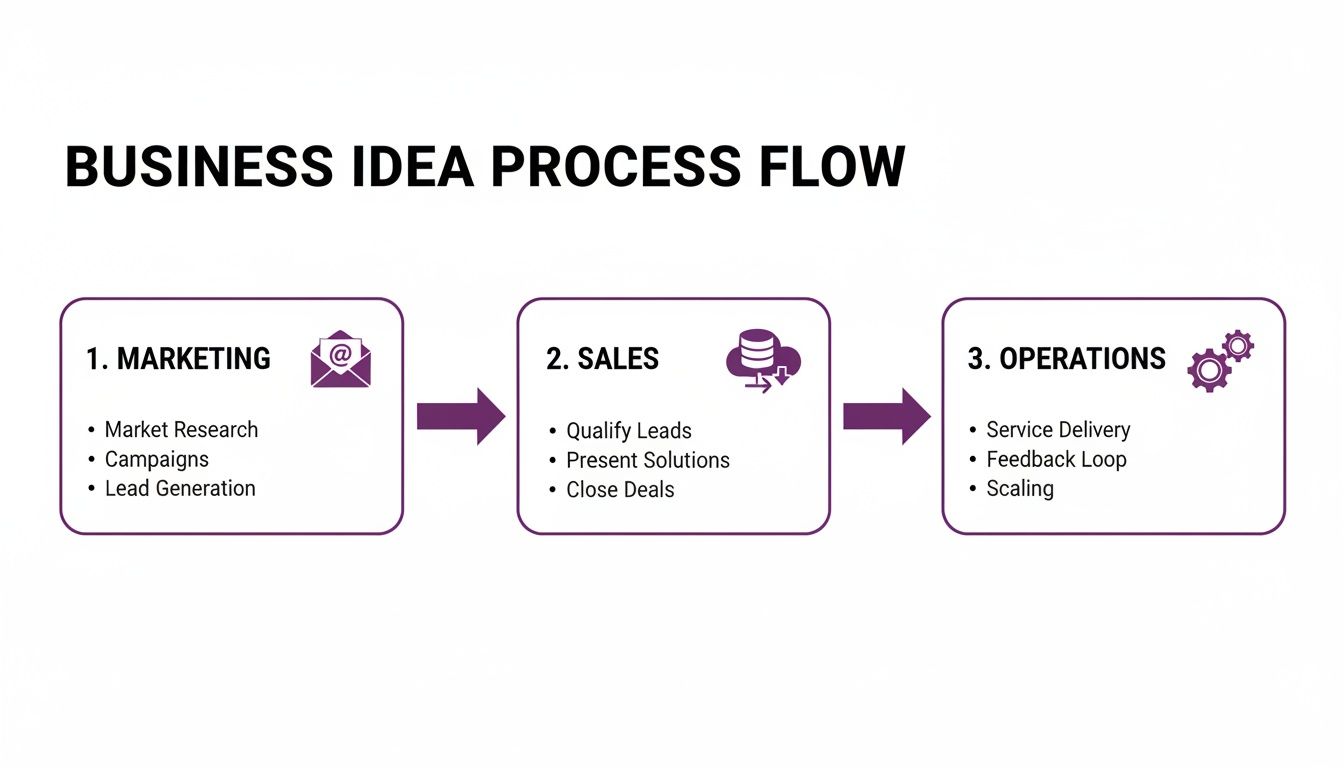
When set up properly, your automations work together as a single, connected system. The result is a more efficient business and a far better client experience.
Phase 1: Identify Your Quick Wins
Before looking at software, audit your daily workflows. Where does work get stuck? What jobs are repetitive and prone to human error?
Jot down the manual tasks your team handles. Focus on areas where time is wasted or customers are slipping through the cracks. Look for these common culprits:
- Lead Response Time: How long does it take to reply to a new website enquiry? Reducing this to minutes is a powerful first step.
- Booking Meetings: Are you still emailing back and forth to find a time? This is perfect for automation.
- Invoicing and Chasing Payments: How many hours are spent creating and following up on invoices?
- Manual Data Entry: Is anyone copying information from one system to another, like from a contact form into your CRM?
Pick one pain point to tackle first. The goal is to solve a real problem that will either free up your team’s time or directly improve your lead conversion rate.
Phase 2: Choose and Connect the Right Tools
Once you have a target, choose the right tool. The best automation platform is one that connects with the systems you already use. There’s no need to rip and replace everything.
Modern automation tools are the glue between your software. They integrate smoothly with platforms most Australian businesses already have, like:
- Your WordPress website
- Your CRM (e.g., HubSpot or Salesforce)
- Your accounting software (e.g., Xero or MYOB)
- Your Google Business Profile
The goal is to enhance your existing tech stack, not force a costly overhaul. The right tools build bridges between your systems, creating a unified workflow that works quietly and efficiently in the background.
For example, if your biggest problem is slow lead response times, a tool like Zapier can connect your WordPress contact form directly to your email marketing platform and CRM. The moment a lead fills out the form, an automation can instantly send a confirmation email and create a task for your sales team.
Phase 3: Roll Out, Test, and Measure
With a clear problem and the right tool, it’s time to build your first automation. Start small, test everything, and measure the impact.
- Build Your First Workflow: Set up the automation to solve the single pain point from Phase 1.
- Test It Internally: Run a few tests to ensure it works as expected.
- Go Live and Monitor: Once confident, switch it on and keep a close eye on it.
- Measure Your Success: This is the most important step. Track the key performance indicators (KPIs) that prove your automation is working.
Your KPIs should be simple and directly related to the problem. For example:
- Metric: Average Lead Response Time
- Before: 4–6 hours
- After: Instant
Or maybe it’s about saving time:
- Metric: Admin Hours Spent on Invoicing
- Before: 8 hours per week
- After: 1 hour per week
By measuring these outcomes, you build a rock-solid business case for doing more. You’ll have hard data showing the ROI, making it easy to get buy-in to tackle the next pain point on your list.
Avoiding Common Pitfalls On Your Automation Journey
Getting started with automation is an exciting step, but it comes with predictable hurdles. Knowing these from the get-go means you can sidestep them, ensuring your investment in business automations delivers results.
Too many businesses stumble into the same traps, from choosing the wrong software to failing to get the team on board. By understanding these pitfalls upfront, you can build a smarter, more successful plan from day one.
Choosing Mismatched Tools
A common mistake is picking automation software that doesn’t talk to the systems you already rely on. The aim is to find tools that integrate neatly with your existing WordPress site, CRM, or accounting software like Xero.
A disconnected tool just creates another silo. Before you commit to any platform, double-check its integration capabilities. This ensures data flows where it needs to without manual intervention.
The right automation tool acts as the central nervous system of your digital operations, connecting disparate platforms into a cohesive whole. The wrong one just adds complexity.
Overlooking Team Adoption and Training
You can set up the most brilliant automation, but if your team doesn't understand it, like it, or feels threatened by it, it's dead on arrival. It’s critical to explain the "why" behind the changes.
Frame automation not as a robot replacing jobs, but as a tool to eliminate boring, repetitive tasks. This frees them up for work that requires a human touch, like strategy or client relationships.
- Communicate the Benefits: Show how automation will reduce their admin workload and give them time for high-value activities.
- Provide Simple Training: Run straightforward, hands-on training so everyone feels confident with the new systems.
- Start with a Champion: Find one person on your team who is enthusiastic about the change and empower them to lead the rollout.
Neglecting Data Security and Compliance
When you automate processes that handle customer information, data security is non-negotiable. Compliance with Australian regulations like the Privacy Act is a legal requirement. You must be certain that any data passing through your automated workflows is secure and handled correctly.
This means choosing reputable software providers with a proven security track record and understanding how your automations store and move data. Overlooking this exposes your business to massive legal and reputational risks, wiping out any efficiency gains.
Frequently Asked Questions About Business Automations
To help you move forward with confidence, we’ve gathered the key questions Australian business owners ask when looking at business automations, with clear, no-nonsense answers.
How Much Do Business Automations Cost?
This is usually the first question, and the answer is: it scales with you. Costs can range from affordable monthly subscriptions for single-task software to more involved, custom-built solutions for complex workflows.
The real focus, however, should be on the return on investment (ROI). A well-chosen automation pays for itself quickly through hours saved, mistakes avoided, and more leads converted. Even a small investment can deliver a huge payback.
Will I Need to Replace My Current Website or CRM?
Almost certainly not. Modern automation platforms are the "glue" that connects the systems you already use, like WordPress, Xero, and most CRMs. The goal is to make your existing tech work together more efficiently, not force a costly overhaul.
Great automation works with what you already have. It connects your systems to create a seamless flow of information and gets rid of the need to manually copy-paste data between platforms.
What Is the Best First Automation for a Service Business?
For a trade or professional service business, the best place to start is often with your lead response process. This is a high-impact, low-complexity win you’ll see results from almost immediately.
Set up an automation that instantly replies to every new enquiry from your website contact form or your Google Business Profile. This confirms you've received their message, provides initial info, and ensures you're the first to respond—dramatically increasing your chances of winning the job.
Ready to unlock your business's potential with smart automation? DigitUX specialises in creating practical, high-ROI automation and digital transformation strategies for Australian businesses. Book a no-obligation strategy call to discover how we can help you build a more efficient, visible, and scalable business. Find out more at https://digitux.com.au.