




Ever wondered how Google displays star ratings, opening hours, or FAQs directly in the search results, before you even click a link? This isn't magic; it's a powerful SEO technique called schema markup. For Australian businesses aiming to increase online visibility and drive qualified leads, understanding and implementing schema is no longer optional—it's a critical component of a successful digital strategy.
In simple terms, schema markup is a type of code added to your website that translates your content into a structured language search engines like Google can instantly understand. This clarity allows your website to qualify for "rich results," making your listings more prominent and informative. At DigitUX, we leverage schema as part of a holistic digital transformation strategy, turning your website into a powerful asset that communicates effectively with both users and search engines.
What Is Schema Markup Explained Simply

Imagine your website is a detailed business report. Without any help, Google has to read every word to figure out what’s important. It’s effective, but it involves guesswork. Schema markup acts as a clear, concise executive summary, highlighting the key information for Google.
This code works behind the scenes, so it doesn’t change how your website looks to visitors. Instead, it provides explicit instructions to search engine crawlers, clarifying the meaning and context of your content.
From Words to Meaning
For an Australian business, this makes a world of difference. Your website might list your business name, address, and services. To a search engine, these are just strings of text.
With schema markup, you can be crystal clear:
- "This text is our official business name."
- "This is our physical address in Brisbane, Queensland."
- "These are our opening hours (AEST)."
- "This is a service we offer, and here is its price."
This structured data eliminates ambiguity. Is that number on your contact page a phone number, an ABN, or a price? Schema tells Google exactly what it is, which is the first step toward unlocking powerful features in search results and automating lead qualification.
A Digital Business Card for Search Engines
The best way to think of schema is as a detailed digital business card you hand directly to Google. A standard website might tell Google you’re a plumber in Sydney. A website with schema markup gives them the full story.
It provides a structured summary, declaring: "We are a licensed plumbing business located in Sydney, open 24/7 for emergencies, with an average customer rating of 4.9 stars based on 85 reviews."
This clarity allows search engines to feature your business more accurately and attractively. It’s a crucial part of modern SEO and Answer Engine Optimisation (AEO), positioning your business not just to be found, but to be understood. In today's competitive digital landscape, that understanding attracts high-intent customers ready to convert.
Why Schema Is a Game Changer for Australian Businesses
For any growth-focused Australian business, a website must be more than a static brochure; it needs to be an active, intelligent tool for lead generation and business automation. Schema markup is the technology that makes this possible. It's not just a technical tweak; it's a strategic advantage that delivers measurable benefits.
By implementing schema, you give your business a megaphone in a crowded digital marketplace. It enables your website to provide clear, structured answers directly in search results, attracting high-intent customers who are ready to take action.
Dominate Local Search and Drive Qualified Leads
To understand schema’s impact, you must first appreciate local search optimization. For a local electrician in Adelaide or a consulting firm in Sydney, visibility in local search is paramount. Schema markup is the engine that drives this.
By using LocalBusiness schema, you can explicitly state your service area, opening hours, phone number, and accepted payment types. This clarity helps Google feature your business in the local map pack, connecting you with customers in your area searching for your expertise right now. To see how this fits into a broader strategy, review our guide to the top local SEO ranking factors.
This isn't just about traffic; it's about efficiency and qualified leads. When a potential customer sees your 5-star rating, service price, and availability directly in search, they are far more likely to click, call, or visit.
Boost Your Click-Through Rate and Visibility
One of the most immediate benefits of schema is the enhanced appearance of your website in search results. Pages with schema can earn "rich snippets"—eye-catching listings with star ratings, FAQs, and product prices. These listings occupy more screen real estate and offer instant value, making users far more likely to click your link over a competitor's plain blue one.
Schema transforms your search listing from a simple text entry into a compelling, data-rich advertisement. It answers user questions before they visit your page, building trust and encouraging a click.
This increased engagement is a powerful signal to Google that your content is highly relevant. The impact is significant; pages with structured data can see up to a 25% higher click-through rate (CTR). This is a massive competitive advantage for any Australian business focused on scalability and growth.
Future-Proof Your Business with Answer Engine & AI Optimisation
Search is evolving. Voice assistants, AI Overviews, and other AI-powered tools are becoming the new search engines. These platforms demand direct, concise answers, not just a list of websites. This is the world of Answer Engine Optimisation (AEO), and schema is its native language.
Schema structures your website’s information so that AI and voice assistants can easily parse and present it. When someone asks their phone, "Find a 24-hour plumber near me," a site with well-structured schema is far more likely to be the source for that direct answer.
By investing in a robust schema strategy today, you’re not just optimising for current search results. You're positioning your Australian business to be the authoritative source in the AI-driven search world of tomorrow, ensuring visibility, efficiency, and sustained lead generation.
The Most Impactful Schema Types for Australian Businesses
Knowing what schema can do is one thing, but applying it strategically is where you’ll see tangible results. For Australian trades and professional services, it’s not about using every schema type available. It’s about selecting the ones that deliver the greatest impact on visibility, lead generation, and business efficiency.
In the competitive Australian market, schema is a genuine game-changer. A Schema App survey found that 40% of businesses using schema have fewer than five employees—proving this isn't an enterprise-level luxury but a vital tool for local growth.
This diagram illustrates how the right schema translates directly into better business outcomes—from improving visibility to boosting click-through rates and, ultimately, generating more qualified leads.
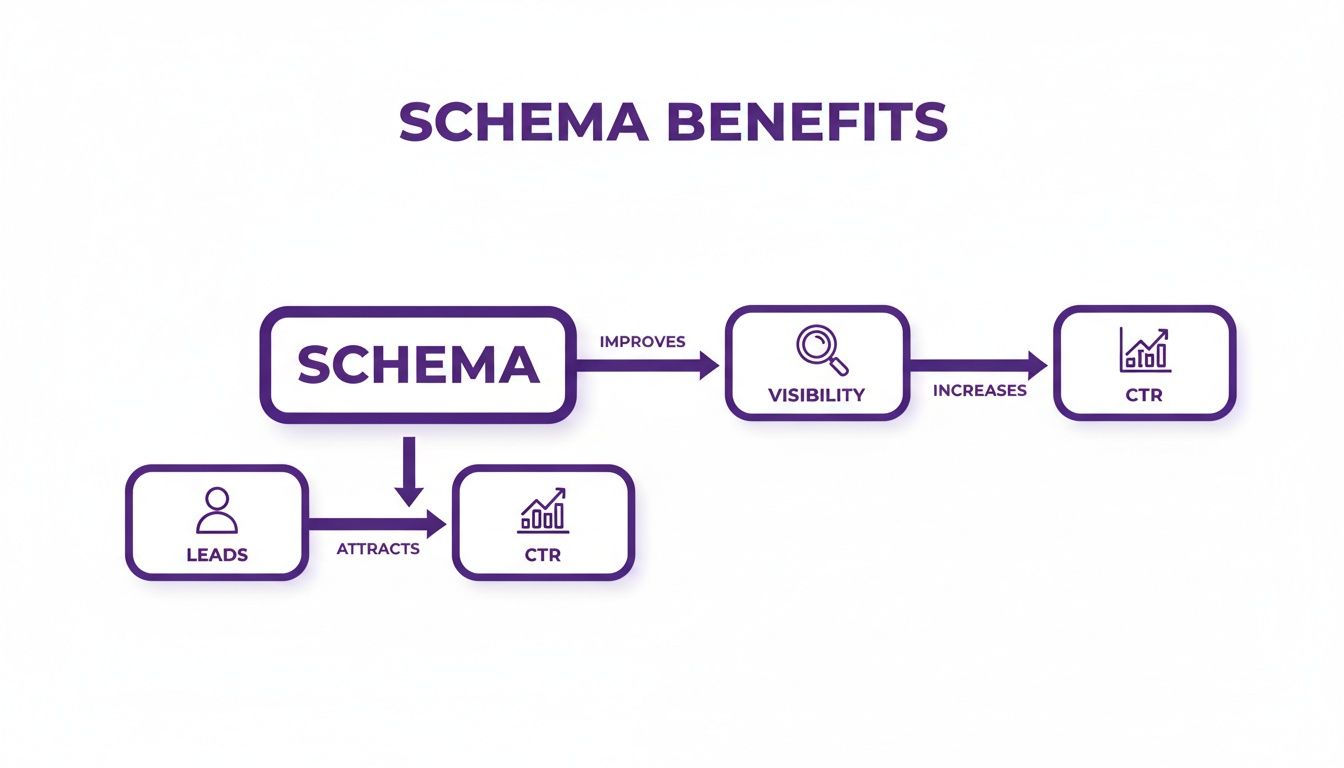
As you can see, each step builds on the last. Enhanced visibility from schema drives more clicks, which in turn generates more qualified enquiries from customers ready to convert.
LocalBusiness Schema: Your Digital Shopfront
For any business with a physical address or a defined service area—like a mechanic in Perth or an accounting firm in Adelaide—the LocalBusiness schema is essential. This code feeds your operational details directly into Google's local search results and the all-important Map Pack.
Think of it as your digital shopfront. It clearly communicates:
- Business Name and Address: The fundamentals for local discovery.
- Opening Hours: Including special hours for public holidays.
- Phone Number: Enabling click-to-call directly from search results.
- Service Area: Critical for tradies and mobile services covering multiple suburbs or an entire region.
Correct implementation is a cornerstone of local SEO. For a practical example, see these proven SEO tactics for construction companies, where local schema is key to showcasing services and project locations.
Service Schema: Detailing What You Do
While LocalBusiness schema tells Google where you are, Service schema defines exactly what you do. For consultants, financial planners, or any service-based business, this is incredibly powerful. It allows you to define each of your offerings as a distinct entity.
A Brisbane-based digital marketing agency, for instance, could use Service schema to mark up offerings like "SEO Audits," "Google Ads Management," and "Business Automation Strategy." This helps you rank for highly specific, high-intent search queries.
This level of detail helps populate features like Google's Knowledge Panel with a clear list of your services, giving potential clients an instant overview of your capabilities. To learn more, read our deep dive on what the Google Knowledge Panel is.
FAQPage Schema: Answering Questions Directly
If you have a frequently asked questions page, FAQPage schema can get those Q&As to appear as an interactive dropdown list directly in the search results.
This is a strategic win for two reasons. First, it positions you as an authority by providing instant answers. Second, it significantly increases the vertical space your listing occupies on the results page, pushing competitors down and making your result more prominent.
By marking up your FAQs, you pre-emptively address customer concerns, building trust and demonstrating expertise before they even click through to your website.
Review and AggregateRating Schema: Building Instant Trust
Social proof is a powerful conversion tool. The Review and AggregateRating schema types allow you to display your hard-earned star ratings directly in the search results.
Imagine a potential customer in Melbourne choosing between two electricians. The one displaying a 4.9-star rating from 50+ reviews holds an immediate and undeniable advantage.
This feature provides an instant visual cue of quality and trustworthiness, making your search listing stand out. It encourages clicks from users who rely on peer validation to make informed decisions.
How to Implement and Test Your Schema Markup
Let's move from theory to action. Implementing schema on your site is more straightforward than you might think, especially for Australian businesses using platforms like WordPress, where powerful tools can automate much of the process.
This is where technical SEO meets smart business strategy. When you implement and validate schema correctly, you provide search engines with a clear roadmap to your content. This is a non-negotiable step in any serious technical SEO checklist.
Your Implementation Options
There are two primary methods for adding schema to your website. The right choice depends on your technical confidence, website platform, and the level of customisation required.
- Use a WordPress SEO Plugin: For most Australian businesses, this is the easiest route. Plugins like Yoast SEO or Rank Math handle basic schema (
Organization,Article) automatically. You fill in your business details in a user-friendly interface, and the plugin generates the required JSON-LD code. - Manual JSON-LD Implementation: For total control or more specific schema types, manual implementation is best. This approach is ideal for custom
Service,Product, orFAQPageschema not covered by plugins. The JSON-LD snippet is placed within the<head>section of your page’s HTML.
Often, a hybrid approach is most effective. Use a plugin for foundational schema and add custom code snippets manually for a specific competitive edge.
A Step-by-Step Guide to Validation
Adding the code is only half the battle. You must test it to ensure it is error-free and eligible for rich results. A single syntax error can render the entire markup useless.
Here’s the simple validation process:
- Generate Your Code: Create your schema script using a plugin or a tool like Google’s Structured Data Markup Helper.
- Use Google’s Rich Results Test: This is the official tool for checking your code. It confirms if your schema is valid and what rich results your page is eligible for. You can paste your code snippet or enter the page URL.
- Analyse the Results: The tool will provide a green tick for valid code or flag the exact errors and warnings that need fixing.
This screenshot shows the Rich Results Test, ready for you to input a URL or code snippet.
A successful validation confirms that Google can correctly interpret your structured data, opening the door to valuable rich results.
Key Takeaway: Validation isn't optional. It’s the quality assurance step that ensures your schema markup can perform its function: communicating clearly with search engines to enhance your visibility and drive business growth.
Once validated, Google will discover your schema during its next crawl. Rich snippets may take a few weeks to appear, but this foundational work paves the way for higher click-through rates, more qualified leads, and a stronger digital presence.
Choosing the Right Schema Format for Your Website

While the concept of schema is universal, the code format—or "syntax"—can vary. For Australian businesses seeking the most effective and future-proof solution, the choice is clear. Getting this technical foundation right is essential for long-term performance and scalability.
JSON-LD: The Modern Standard
JSON-LD (JavaScript Object Notation for Linked Data) is the gold standard for schema markup. It is explicitly recommended by Google because it is clean, efficient, and easy to manage.
Older formats required embedding schema directly into the visible HTML content, which was messy and prone to errors. JSON-LD works differently. It’s a self-contained block of code, typically placed in the <head> section of your website’s HTML. This script communicates directly with search engines without affecting the content your customers see, making it far easier to implement, update, and troubleshoot.
Why Google Prefers JSON-LD
The benefits of JSON-LD extend beyond simple organisation. For any Australian business focused on growth and efficiency, it’s the most logical choice.
- Easier Implementation: A single, tidy script contains all the necessary information.
- Reduced Risk of Errors: Separating schema from visible content prevents accidental issues with your page's layout.
- Scalability: It's simpler to manage and deploy across your entire site, which is crucial as your business grows.
For these reasons, JSON-LD is the format we implement for all our clients at DigitUX. It provides the flexibility and reliability required for a high-performance SEO strategy, ensuring your structured data is both powerful and maintainable.
What About Older Formats Like Microdata and RDFa?
You may still encounter older formats like Microdata and RDFa. These were early methods of embedding structured data directly into the HTML of a webpage.
Here's a quick comparison of the main options.
Comparison of Schema Markup Formats
| Format | Google's Recommendation | Implementation Method | Best For |
|---|---|---|---|
| JSON-LD | Strongly Recommended | A separate script in the page's <head> or <body>. |
All modern websites. It's flexible, easy to manage, and the industry best practice. |
| Microdata | Supported, but outdated | Attributes (itemscope, itemtype) are added directly to HTML tags. |
Legacy websites where a complete code overhaul isn't feasible. Not recommended for new projects. |
| RDFa | Supported, but outdated | Similar to Microdata, it uses attributes within existing HTML tags. | Also best for legacy systems. It's more complex than Microdata and rarely used now. |
While search engines can still understand older formats, they are now considered obsolete. They are more difficult to work with and offer no strategic advantage over JSON-LD. Choosing JSON-LD aligns your business with best practices, ensuring your efforts are recognised effectively by Google now and in the future.
Common Schema Mistakes and Future-Proofing Your SEO
Implementing schema markup correctly is a significant SEO advantage. However, errors can render your efforts invisible to search engines or, worse, send confusing signals that damage your credibility.
Many Australian businesses encounter the same preventable hurdles. A flawed implementation means no rich snippets and none of the intended search benefits—it’s like sending Google an invitation with the wrong address.
Getting the Details Right: An Error-Free Schema Checklist
Clean, error-free code is non-negotiable. One missing comma or an incorrectly formatted date can invalidate the entire script.
To ensure your structured data is an asset, avoid these common mistakes:
- Using the Wrong Schema Type: Be specific. If you are a plumber, use the
Plumberschema, not just the genericLocalBusinesstype. The more precise you are, the better Google understands your services. - Incomplete or Inaccurate Information: Your schema markup must match the content visible to users on the page. Adding a 5-star rating in your code that isn't displayed on your website violates Google’s guidelines and can lead to penalties.
- Ignoring Syntax Errors: A single misplaced bracket or a forgotten quotation mark will invalidate your code. Always validate your schema before and after publishing. Use tools like the official Rich Results Test from Google to catch these critical errors.
A robust schema strategy is not a "set and forget" task. It requires attention to detail and regular audits to ensure you are providing search engines with clean, accurate information that builds trust and authority.
Beyond Rich Snippets: The Future is Answer Engines and AI
If you think schema is just a tactic to get star ratings in search results, you are missing the bigger picture. Structured data is the foundational language for the next generation of search and AI. It is the bedrock of Answer Engine Optimisation (AEO).
AI-driven features like Google’s AI Overviews and voice assistants don't just scan websites for keywords; they seek direct, structured answers. Your schema markup provides these answers, positioning your business as the authoritative source.
When someone asks their smart speaker, "Find a certified electrician in Brisbane that's open now," it’s the LocalBusiness and Service schema that enables the AI to give a confident, direct answer. Without it, your business is effectively invisible in this new search paradigm.
Investing in a proper schema strategy today isn't just about boosting current rankings—it’s about future-proofing your business for an AI-driven world. It’s how you maintain visibility and relevance as search technology evolves.
Got questions about schema markup? You're not alone. It's a topic that can seem technical, but its business impact is immense. Here are straightforward answers to questions we frequently hear from Australian business owners.
How Long Does Schema Take to Show SEO Results?
The effects of schema often appear faster than other SEO initiatives. Once Google re-crawls your updated pages, you could see rich snippets in search results within a few weeks.
The true value builds over time. Enhanced listings improve your click-through rates, which signals relevance to Google and can gradually strengthen your rankings—a significant advantage in competitive local markets like Brisbane or Sydney.
Can I Just Add Schema to My WordPress Site Myself?
Yes, you can. Plugins like Yoast SEO are an excellent starting point for handling basic schema.
However, a generic setup won't be enough to outperform your competitors. Custom schema, perfectly mapped to your unique services and business objectives, is where the real advantage lies. A professional implementation ensures your markup is flawless, comprehensive, and strategically designed to drive results in both current search and future AI-powered answers.
The Bottom Line: Basic schema is good, but a bespoke strategy provides a genuine competitive edge by aligning your data perfectly with customer search intent and search engine requirements.
Is Schema a Direct Google Ranking Factor?
Not directly, but it is one of the most powerful indirect factors. Schema doesn't have a direct impact on your ranking position, but it generates rich snippets that make your website stand out.
This enhanced visibility dramatically boosts your click-through rate (CTR). A high CTR is a strong signal to Google that your page is a relevant answer to a search query, which in turn can positively influence your rankings and overall search authority.
What Happens If I Use the Wrong Schema?
Using incorrect schema can have two outcomes. Best case: Google simply ignores it, and your efforts are wasted.
Worst case: If the markup is perceived as intentionally deceptive, it can lead to a manual penalty from Google, severely harming your site's visibility. This is why accuracy is critical—it ensures your data is compliant and works to your advantage.
Ready to transform your website into a powerful communication tool that speaks Google's language? The team at DigitUX are digital transformation specialists. We design and implement advanced schema strategies that deliver measurable results, increase online visibility, and drive qualified leads.